
How to Sell Furniture Online: Photos, Pricing, and Pickup That Move Items Fast
If you want to know how to sell furniture online without your listing rotting for six weeks, three things matter more than anything else: shoot the piece in indirect daylight from a low angle, price it at 30–50% of current retail with a visible anchor to the new price, and offer paid delivery through uShip or Dolly so out-of-town buyers can actually buy it. That’s the whole game. Facebook Marketplace, Craigslist, OfferUp, and marketplaces like HomeShow.ai all reward the same behaviors — clear photos, defensible pricing, and logistics that don’t force a stranger to rent a U-Haul on a Tuesday.
Everything below is the detail behind those three levers.
Start with the photo setup, not the listing form
Most sellers open the app first and take pictures second. Reverse it. A sofa shot with a phone flash against a beige wall looks like every other sofa in the feed. A sofa shot at 8:30 a.m. next to a north-facing window, with the cushions fluffed and a throw draped diagonally, looks like a magazine.
Here’s the setup that consistently outperforms Marketplace defaults:
- Time of day: Shoot within two hours of sunrise or two hours before sunset. Midday sun creates harsh shadows on upholstery and blows out wood grain.
- Light source: Turn off every overhead light. Indoor bulbs are usually 2700K (warm yellow), while daylight is 5500K (neutral). Mixing them makes white furniture look jaundiced.
- Angle: Get your phone camera at roughly one-third the height of the piece. For a 32-inch-tall sofa, that’s about 10 inches off the floor. Low angles make furniture look substantial. Eye-level shots make it look small.
- Distance: Stand back and use the 1x lens, not the 0.5x wide angle. Wide-angle warps proportions and buyers can tell something’s off even if they can’t name it.
- Background: Push the piece 2–3 feet away from the wall so it doesn’t look like it’s glued to the drywall. Clear the floor within the frame.
Take eight to twelve photos, not four. The sequence that converts:
- Hero shot — full piece, styled, in natural light.
- Straight-on front, unstyled, so buyers can see the actual silhouette.
- Both side profiles.
- Back of the piece (critical for anything that might float in a room).
- Close-up of the upholstery weave, wood grain, or finish.
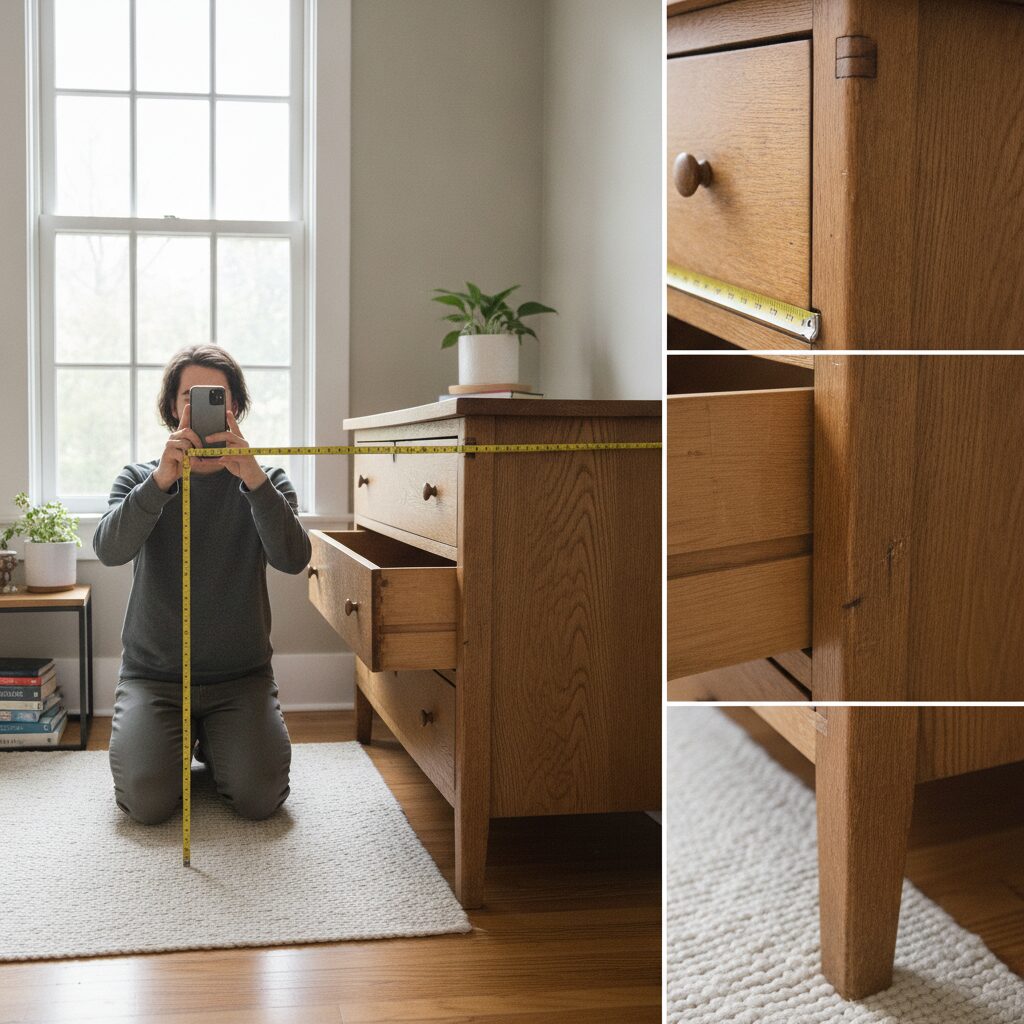
- Legs and joinery — buyers looking for quality want to see corner blocks and dovetails.
- Every flaw, close-up, in good light. A cat-scratched armrest photographed honestly builds more trust than a listing that hides it.
- Tape measure laid across the width, depth, and height in three separate shots.
The tape measure photos are the secret weapon. They cut down “will this fit through my door?” messages by roughly half, which means fewer no-shows and faster sales.
Write the description like a spec sheet, not a poem
Buyers skim. They’re looking for six data points, and if they can’t find them in ten seconds they bounce.
Lead with this block, then add color underneath:
- Dimensions: W × D × H in inches. Include seat depth for sofas and chairs.
- Brand and model: If you have it. “West Elm Harmony 82-inch” pulls searches. “Gray couch” does not.
- Age and original price: “Purchased new from Room & Board in March 2022 for $2,450.”
- Condition: Specific. “Small stain on left cushion, shown in photo 7. No pet or smoke exposure.”
- Reason for selling: One sentence. Buyers relax when they know it’s a move, not a defect.
- Pickup or delivery terms: Address neighborhood, days available, and whether you offer paid delivery.
Search matters here. The AI-assisted listing tool on HomeShow.ai will pull brand, dimensions, and category directly from your photos, but you still want to write two or three natural sentences with the terms real buyers type: “mid-century walnut credenza,” “sectional with chaise,” “solid oak dining table seats six.” Facebook’s search is keyword-literal. So is Google, which increasingly indexes marketplace listings.
Price against retail, not against other used listings
The most common pricing mistake is scrolling Marketplace, seeing three similar sofas priced at $400, and pricing yours at $395. That’s a race to the bottom, and it ignores what buyers actually anchor to: the current price at the store.
The framework that works:
| Piece condition | Percentage of current retail | Example |
|---|---|---|
| Like-new, under 1 year old | 60–70% | $1,500 sofa → $900–$1,050 |
| Excellent, 1–3 years old | 40–55% | $1,500 sofa → $600–$825 |
| Good, 3–7 years old | 25–40% | $1,500 sofa → $375–$600 |
| Fair, visible wear | 15–25% | $1,500 sofa → $225–$375 |
| Vintage/antique with demand | Can exceed original retail | Depends on maker |
Then anchor it in the listing itself. “Retails new for $1,499 at CB2 today — asking $650” outperforms “$650 OBO” by a wide margin. You’re giving the buyer permission to feel smart. That’s what closes the deal.
A few pricing rules of thumb that hold up:
- Ikea and other flat-pack furniture depreciates faster — start at 20–30% of retail even in good condition. Buyers know reassembly is risky.
- Solid wood holds value better than veneer. A real walnut dresser at seven years old can still fetch 50%. A veneered version at three years might fetch 25%.
- Sectionals and dining sets sell slower than accent pieces. Price them 10% below what the math says if you need to move quickly.
- Never end in .00 or .99. $625 outperforms $600 and $599 in most tests — it looks considered rather than lazy or gimmicky.
Build in a 10–15% negotiation buffer. Almost every buyer will ask. Saying “I can do $575” on a $625 ask feels like a win to them and costs you nothing you didn’t already plan.
Solve the pickup problem before a buyer asks
“Local pickup only” is a filter that removes about 80% of your potential buyers. Anyone without a truck, anyone across town during rush hour, anyone in a walk-up apartment — gone. This is the single biggest reason large items sit unsold.
Two services fix this for casual sellers:
Dolly for same-city moves
Dolly connects you with local “Helpers” who show up with a pickup truck or box van, usually within a few hours. Typical cost for a single-item move within a metro like Austin runs $65–$150 depending on distance, stairs, and whether it’s a two-person job. The buyer books and pays; you just hand off the item. Best for anything within 30–40 miles.
uShip for anything farther
uShip is an auction-style freight marketplace. You list the pickup and drop-off locations, the item, and rough dimensions, and independent carriers bid on the job. A dresser from Austin to Dallas typically runs $150–$250. A full sectional coast-to-coast might be $400–$700. Slower than Dolly (usually 3–10 days), but it unlocks a national buyer pool.
The way to present this in your listing:
Local pickup in 78704, or I’ll coordinate delivery through Dolly (same-day, ~$85 within Austin) or uShip (2–7 days, quote on request). Buyer pays delivery.
That one sentence turns your listing from “person with couch” into “actual small business.” HomeShow.ai bakes uShip and Dolly integration directly into listings, so a buyer in Houston can request a delivery quote without either party leaving the app. If you’re listing on Marketplace or Craigslist, you can still offer it manually — just get a rough quote before you list so you can answer questions fast.
Handle messages and no-shows without losing your weekend
The pattern most casual sellers fall into: reply immediately to every “is this still available?” message, then get ghosted by six of eight buyers. Reverse the leverage.
- Batch replies. Answer messages twice a day, morning and evening. Serious buyers wait. Tire-kickers give up.
- Ask a qualifying question in your first reply. “Yes, still available. What day works for pickup?” A buyer who names a day is 5x more likely to show up than one who says “cool, I’ll let you know.”
- Confirm 90 minutes before pickup. A quick “Still on for 4pm? I’ll have the piece out front” flushes out no-shows before you rearrange your day.
- Cash, Zelle, or Venvo — no checks, no wire transfers, no gift cards. If a buyer offers to “send a courier with a cashier’s check,” it’s a scam. Every time.
- First confirmed buyer gets it. Don’t hold pieces for people who won’t commit to a time. Say so in the listing.
Where casual sellers give up money without realizing
A few quiet mistakes cost real dollars:
- Selling a matching set as one listing. Split a bedroom set into dresser, nightstands, and bed frame. You’ll gross 30–40% more, even accounting for the extra logistics.
- Ignoring seasonality. Patio furniture sells in April and May, not September. Dining tables move in the two weeks before Thanksgiving. Time your listings.
- Skipping the receipt or warranty transfer. If the piece is under 5 years old and the manufacturer allows transfer, mention it. A transferable warranty on a $2,000 mattress can add $100–$200 to what buyers will pay. If you’re tracking receipts and warranty windows in something like HomeShow.ai’s HomeVault, this data is already at your fingertips.
- Deleting and relisting instead of refreshing. On most platforms, deleting kills your view count and buyer interest history. Edit the price down $25 instead. It bumps the listing without resetting the clock.
A realistic timeline for a well-listed piece
If you’ve done the photos, pricing, and pickup work above, here’s what to expect for a $650 sofa in a metro like Austin:
- Hours 0–24: 5–15 inquiries, most low-effort. Reply to the ones who name a day.
- Days 2–4: 1–3 serious buyers scheduling a viewing or requesting a delivery quote.
- Day 5–10: Sold, or price drops $50 and cycle repeats.
- Day 14+: If it hasn’t moved, the photos or price are wrong. Reshoot in different light before dropping the price again.
Furniture that sits for 30+ days almost always has a photo problem, not a price problem. The sellers who consistently clear pieces in under a week aren’t lucky — they’re doing the boring work of shooting eight good photos, anchoring to retail, and quoting a delivery number before anyone asks.