Water Heater Replacement Cost in Austin: Tank vs Tankless vs Heat Pump in 2026
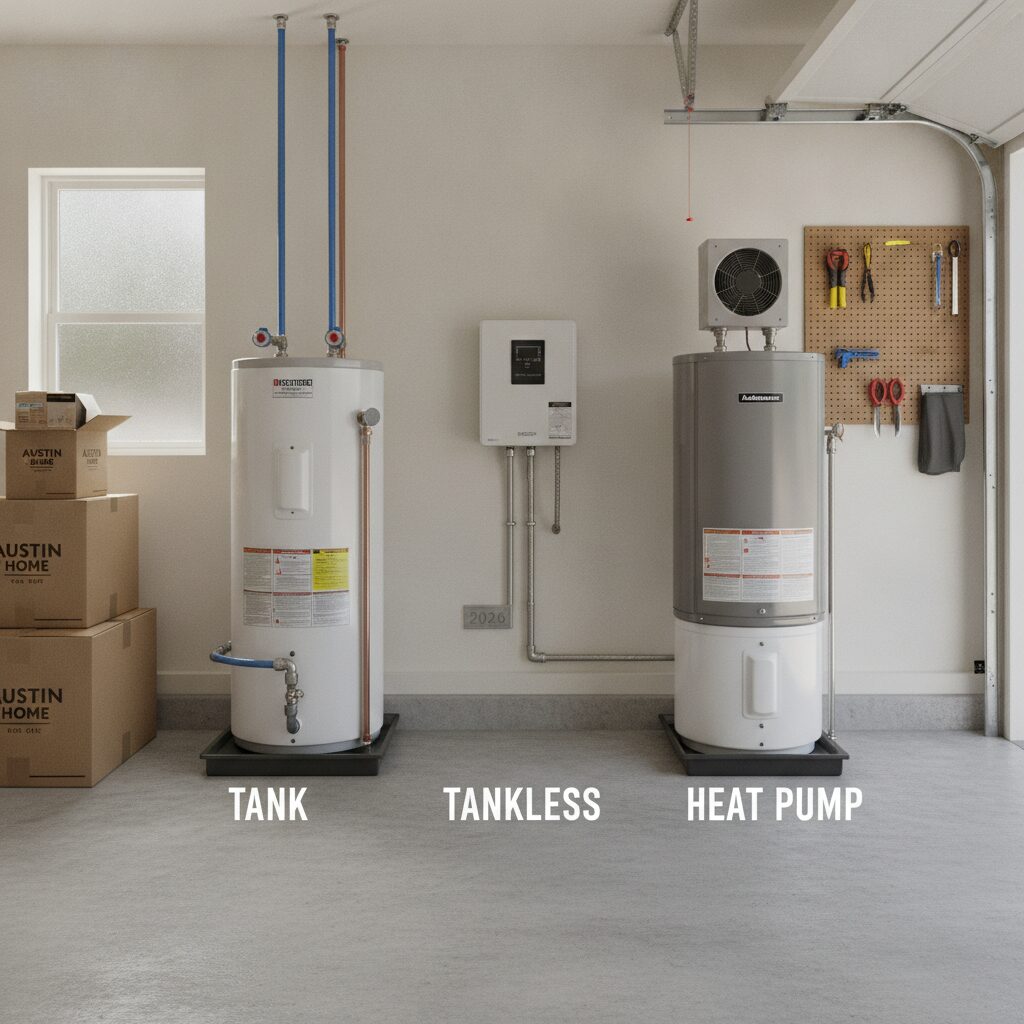
Water heater replacement cost in Austin runs $1,800–$3,200 for a standard 50-gallon gas tank, $3,800–$6,500 for a tankless unit, and $4,500–$7,800 for a hybrid heat pump — all installed, with permit, in 2026. Austin Energy rebates knock $700–$1,600 off the heat pump option and up to $600 off qualifying tankless installs. The variable that actually blows budgets isn’t the appliance. It’s whether your existing gas line, flue, or electrical panel can support the new unit without an upgrade that adds $600–$2,500 to the invoice.
Below is what each option really costs in Travis and Williamson counties right now, where the hidden line items hide, and which unit makes sense for which house.
2026 Installed Pricing at a Glance
These are median installed prices from Austin-area plumbing contractors as of Q1 2026, covering equipment, standard labor, permit, and haul-away. They assume a like-for-like swap in an accessible location (garage, utility closet, or attic platform).
| Unit Type | Equipment | Labor + Permit | Typical Installed Total | Lifespan |
|---|---|---|---|---|
| 50-gal atmospheric gas tank | $750–$1,200 | $900–$1,600 | $1,800–$3,200 | 10–12 yrs |
| 50-gal electric tank | $650–$1,100 | $800–$1,400 | $1,600–$2,800 | 10–13 yrs |
| Tankless gas (condensing) | $1,400–$2,600 | $2,000–$3,900 | $3,800–$6,500 | 18–22 yrs |
| Hybrid heat pump (50–80 gal) | $1,800–$3,200 | $2,200–$4,000 | $4,500–$7,800 | 13–15 yrs |
The permit itself is cheap. City of Austin residential plumbing permits for a water heater swap run about $109 plus a $52 inspection fee. Round Rock, Cedar Park, and Pflugerville are in the same ballpark. Skipping the permit is a bad idea — it voids most manufacturer warranties and shows up in the sellers disclosure when you list the house.
The 50-Gallon Gas Tank: Still the Default, Still the Cheapest
For roughly 70% of Austin homes built before 2015, a standard atmospheric-vent 50-gallon gas tank is the path of least resistance. A Rheem Performance or Bradford White RG250T6N drops into the same footprint, uses the existing 3/4″ gas line and B-vent flue, and a competent plumber is out in four hours.
Where it gets more expensive:
- Attic installs. If your unit is in the attic (common in Circle C, Steiner Ranch, and most 1990s–2000s tract homes), add $200–$400 for a new drip pan, expansion tank, and code-compliant platform.
- Expansion tank retrofit. Required since 2009 for any home with a pressure-reducing valve. If yours is missing or corroded, that’s another $180–$275 installed.
- Flue liner or venting fix. Older homes in Hyde Park, Travis Heights, and Clarksville sometimes need the B-vent re-sized or re-flashed. Budget $300–$700.
Power-vent gas models (which don’t need a chimney flue and can sit in a closet) run $2,700–$4,000 installed. They’re the right call when you’re moving the heater’s location or when the existing flue is compromised.
Tankless: Where the Budget Actually Explodes
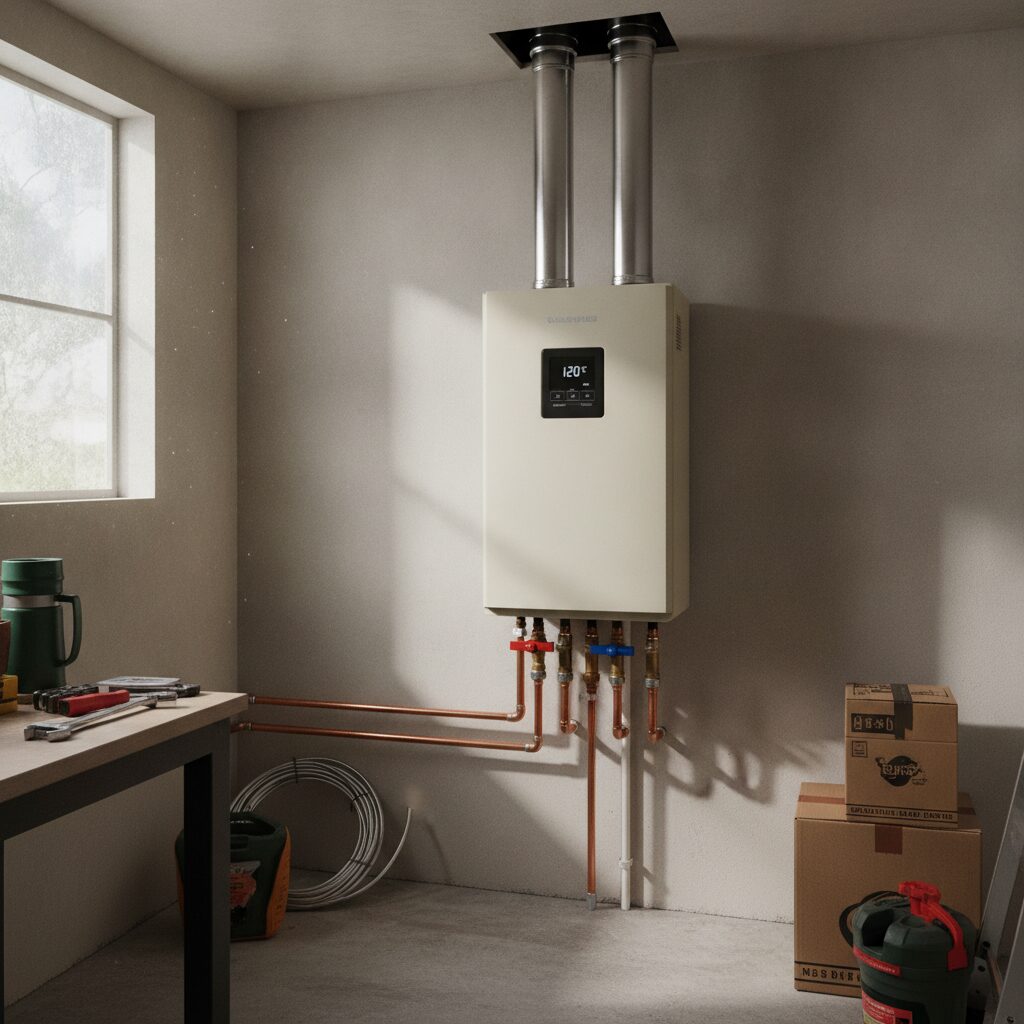
A Navien NPE-240A2 or Rinnai RSC199iN costs $1,500–$2,200 for the unit alone. That’s not the problem. The problem is that a tankless burns 180,000–199,000 BTU/hr while a tank heater tops out around 40,000 BTU/hr. Your existing 1/2″ gas line — standard for tank installs — physically cannot deliver that volume.
The gas line upgrade nobody warns you about
Nine out of ten Austin homes need the gas line stepped up from 1/2″ to 3/4″ (or sometimes 1″) from the meter to the unit. If the run is short and accessible (garage-mounted heater, unit near the meter), that’s $400–$700. If the run crosses a finished ceiling or goes through a slab, it’s $1,200–$2,500. I’ve seen a Mueller-area 1960s pier-and-beam bid at $3,100 just for the gas line because the plumber had to trench under the house.
You may also need:
- New venting. Condensing tankless units use PVC or polypropylene vent, not the old B-vent. Add $250–$600.
- Meter upgrade. If you also have a gas range, gas dryer, and gas furnace, Texas Gas Service may need to swap your meter for a higher-capacity one. That part is free, but the plumbing to accommodate it isn’t.
- Condensate drain. Condensing tankless produces acidic condensate. It needs a drain within a few feet, or a condensate neutralizer ($90) plus a pump ($180).
A “clean” tankless install in a 2010-or-newer home where the heater is in the garage near the meter is genuinely $3,800–$4,500. A tankless retrofit in a 1970s Barton Hills bungalow with the heater in an interior closet? I’ve seen $7,200 quotes that were honest.
When tankless is worth it
Run the math on lifespan, not monthly savings. A tankless lasts about twice as long as a tank. If you plan to stay in the house 15+ years, it wins. Endless hot water is real — useful for households with three or more people showering back-to-back, or for filling a big soaking tub. Gas savings are modest in Austin (roughly $70–$140/year over a tank) because our incoming water is warm most of the year and standby losses are already low.
Hybrid Heat Pump: The Rebate Story Changes Everything
A heat pump water heater (Rheem ProTerra, A.O. Smith Voltex, or the newer Bradford White AeroTherm) uses a small compressor to pull heat out of surrounding air and dump it into the tank. It uses about 60–70% less electricity than a resistance electric tank and, in Austin’s climate, actually works year-round because garages and utility rooms stay above 45°F even in January.
Installed cost before rebates: $4,500–$7,800. After rebates, it’s often the cheapest option over 10 years.
Austin Energy rebate stack in 2026
- Austin Energy Heat Pump Water Heater rebate: $700–$1,600 depending on efficiency tier (UEF ≥ 3.3 qualifies for the top tier).
- Federal 25C tax credit: 30% of installed cost, capped at $2,000. This is a credit against taxes owed, not a rebate at point of sale.
- City of Austin HPWH pilot bonus: An additional $500 in 2026 for homes replacing a resistance electric tank (verified via the utility bill).
Stack them and a $6,000 install can net out around $2,900–$3,400. That’s below the price of a mid-range tankless and only slightly above a basic gas tank.
Where heat pumps get expensive
They need three things: 700+ cubic feet of surrounding air (or ducting to a larger space), a condensate drain, and a 240V/30A circuit. In a garage, all three are usually easy. In an interior closet, you’ll need louvered doors or a duct kit ($200–$450) and possibly a condensate pump.
The panel question is the real one. If you’re replacing a gas heater with a heat pump, you need a new 240V circuit run to the location. In a home with a 100-amp panel that’s already near capacity (older East Austin homes, many pre-1985 builds), you may need a panel upgrade — $2,200–$4,000 — before you can add the circuit. A load calculation from a licensed electrician ($150–$250) is money well spent before you commit.
Total Cost of Ownership Over 12 Years
Sticker price lies. Here’s what each option actually costs an Austin family of four using ~60 gallons/day of hot water, using current Texas Gas Service and Austin Energy rates.
| Option | Installed (net rebates) | 12-yr energy cost | Est. maintenance | 12-yr total |
|---|---|---|---|---|
| Gas tank, 50 gal | $2,400 | $3,600 | $400 | $6,400 |
| Tankless gas | $4,800 | $3,100 | $900 (descaling) | $8,800 |
| Heat pump (post-rebate) | $3,200 | $1,900 | $500 | $5,600 |
The heat pump wins on 12-year total in most Austin scenarios where the panel already supports it. Tankless only comes out ahead if you’re extending well past its 20-year lifespan — say you’re 45 years old, buying a forever home, and would otherwise replace a tank twice. Then it pencils.
How to Actually Get a Fair Quote in Austin
Three-bid rule still applies, but the bids need to be apples-to-apples. Ask each contractor to itemize:
- Equipment model number and UEF (Uniform Energy Factor) rating.
- Gas line size and whether an upgrade is included.
- Venting material and length.
- Expansion tank and shutoff valves (yes/no included).
- Permit fee — should be a pass-through, not marked up 3x.
- Haul-away and disposal.
- Labor warranty (1 year is standard; 2 years is better).
Red flags: a quote below $1,600 for a gas tank swap almost always skips the permit. A tankless quote below $3,500 usually assumes your gas line is already sized correctly — get that in writing. And anyone quoting a heat pump without asking about your panel amperage hasn’t done a real site visit.
If you’re managing multiple homes, or just want to keep serial numbers, install dates, and warranty documents in one place, tracking the new unit in a home inventory tool the moment it’s installed pays off the next time it fails at 11 PM on a Sunday. You’ll know the model, the installer’s phone number, and whether it’s still under warranty in about six seconds.
Which One Should You Actually Buy?
Short version:
- Buy a gas tank if your current heater is gas, you’re staying under 5 more years, and the existing venting is fine. Fastest, cheapest, done.
- Buy a tankless if you’re in a newer home (2010+) with the heater near the meter, you plan to stay 10+ years, and endless hot water genuinely matters to your household.
- Buy a heat pump if your current heater is electric, you have a garage or utility room with airflow, and your panel has capacity. The rebate stack makes this the smart-money pick for most Austin homes replacing an electric tank.
The honest truth: for a lot of homeowners, the “best” water heater is the one that a licensed, permitted plumber can install this week without opening walls. The unit you replace it with in 2038 will be a heat pump regardless. In 2026, the question is just how much upgrade you want to pay for now.