Solar Panel Cost in Texas 2026: Payback Period by City and Utility
Solar panel cost in Texas in 2026 lands between $2.40 and $3.10 per watt installed, or roughly $18,000–$26,000 for a typical 7.5 kW system before incentives. After the 30% federal Residential Clean Energy Credit, most homeowners write a net check of $12,600–$18,200. Payback periods now range from about 7 years in CPS Energy territory (San Antonio) to 13–14 years in CenterPoint territory (Houston), driven almost entirely by how each utility compensates exported solar. The 30% federal tax credit is scheduled to drop to 26% for systems placed in service in 2027, so 2026 is the last full year at the top rate.
Below is what real quotes, real buyback rates, and roof-orientation math actually look like across the four utilities most Texans deal with.
What solar actually costs in Texas right now
The statewide average has drifted downward since 2023. Panel prices collapsed after Chinese oversupply hit U.S. distributors in late 2024, and installers have passed maybe half of that through to homeowners. Labor and permitting haven’t budged.
Here’s the 2026 pricing spread we’re seeing from mid-size Texas installers (Freedom Solar, Sunpro, Longhorn Solar, Alba Energy, and a handful of Austin-based shops):
| System size | Low quote ($/W) | Typical ($/W) | Premium tier ($/W) | Net cost after 30% credit (typical) |
|---|---|---|---|---|
| 5 kW | $2.55 | $2.90 | $3.40 | $10,150 |
| 7.5 kW | $2.40 | $2.75 | $3.20 | $14,440 |
| 10 kW | $2.30 | $2.60 | $3.05 | $18,200 |
| 12 kW + battery (13.5 kWh) | $3.10 | $3.55 | $4.10 | $29,820 |
Premium tier means Enphase IQ8 microinverters, REC or Maxeon panels, and a 25-year workmanship warranty. The “low quote” column is usually string inverters (Solis, Sol-Ark without battery), Tier 1 Chinese panels, and a 10-year labor warranty. Both work. The premium tier just ages better in Texas heat, where attic-mounted inverters routinely see 140°F.
Battery adders sit at $9,000–$12,000 installed for a 13.5 kWh Franklin aPower or Tesla Powerwall 3 after the federal credit. Batteries pay themselves back only if you’re on a time-of-use rate or you value backup during ERCOT emergency alerts.
The 30% federal tax credit: what actually changes in 2027
The Residential Clean Energy Credit stays at 30% through December 31, 2026. Systems “placed in service” (meaning inspected, PTO’d, and operational) in 2027 drop to 26%, then 22% in 2028, and the residential credit expires after that under current law.
Two practical implications:
- Contract by August 2026 if you want to be safe. Oncor and CenterPoint interconnection queues stretched to 90–120 days during the 2025 rush. A signed contract in September doesn’t guarantee 2026 PTO.
- The credit is nonrefundable but carries forward. If your federal tax liability is $4,000 and your credit is $5,400, you use $4,000 this year and roll $1,400 to 2027. Retirees with low tax liability sometimes never fully capture it — worth modeling before you sign.
Texas has no state income tax credit and no state rebate. Everything worthwhile is either federal or utility-specific.
Payback period by utility: the four that matter
Utility choice is the single biggest lever on payback in Texas. Same house, same roof, same system — the payback can differ by six years depending on who buys back your exported kilowatt-hours.
Assumptions for every scenario below: 7.5 kW system, $20,600 gross cost, $14,420 net after federal credit, south-facing composition shingle roof at 25° pitch, 11,200 kWh annual production, 14,000 kWh annual household consumption, 3% annual electricity price inflation.
Austin Energy (Austin, parts of Travis County)
Austin Energy uses a Value of Solar (VoS) tariff, currently $0.097/kWh in 2026, applied to all production (not just exports). Your regular consumption is billed at the standard tiered rate. It’s clean math but not net metering — you pay the full retail rate for imports and get the VoS credit for everything you generate.
- Annual bill offset: ~$1,780
- Austin Energy solar rebate: $2,500 flat (still active in 2026, capped funding, first come first served)
- Net cost after federal credit and rebate: $11,920
- Payback: 6.5–7 years
Austin is the best-case utility in Texas, largely because of that rebate. Miss the rebate window and payback slips to 8 years.
CPS Energy (San Antonio)
CPS runs true 1:1 net metering up to your monthly consumption, then pays wholesale (~$0.035/kWh) for excess. Their rebate program pays $0.60/watt DC, capped at $4,200 for standard installs and up to $4,500 for local-panel installs. That’s the most generous utility rebate in the state.
- Annual bill offset: ~$1,650
- CPS rebate (typical): $4,200
- Net cost: $10,220
- Payback: 6–7 years
San Antonio quietly has the best solar economics in Texas. Homeowners who compare CPS Energy solar buyback terms with anything else in the state usually go solar within a month.
Oncor (Dallas–Fort Worth, most of North Texas)
Oncor is a wires-only utility. Your buyback rate depends on your Retail Electric Provider (REP). This is where shopping matters. Rhythm’s “Simply Solar,” Chariot’s “Solar Buyback,” and Green Mountain’s “Renewable Rewards” all offer 1:1 net metering, but the underlying energy rate can range from $0.11 to $0.17/kWh.
- Annual bill offset (at $0.13/kWh REP): ~$1,455
- Oncor residential solar rebate: up to $2,500 (funding often exhausted by Q2)
- Net cost: $11,920
- Payback: 8–10 years
The variability is real. A homeowner in Frisco on a bad REP plan can see 12-year payback; the same house on Rhythm’s solar plan hits 8.
CenterPoint (Houston metro)
Also wires-only, also REP-dependent, but with a catch: fewer REPs offer genuine 1:1 buyback in CenterPoint territory, and the ones that do often build the cost into a higher base rate. MP2, Reliant, and Gexa have solar buyback plans that pay retail for exports up to your usage.
- Annual bill offset (typical Reliant Simple Solar Sell Back): ~$1,280
- CenterPoint rebate: none as of 2026
- Net cost: $14,420
- Payback: 11–14 years
Houston has the harshest solar math among the four majors. High summer AC loads help (you’re using what you produce), but the lack of a utility rebate and weaker export credits stretch payback close to the panel warranty midpoint.

Roof orientation: which directions actually pay off
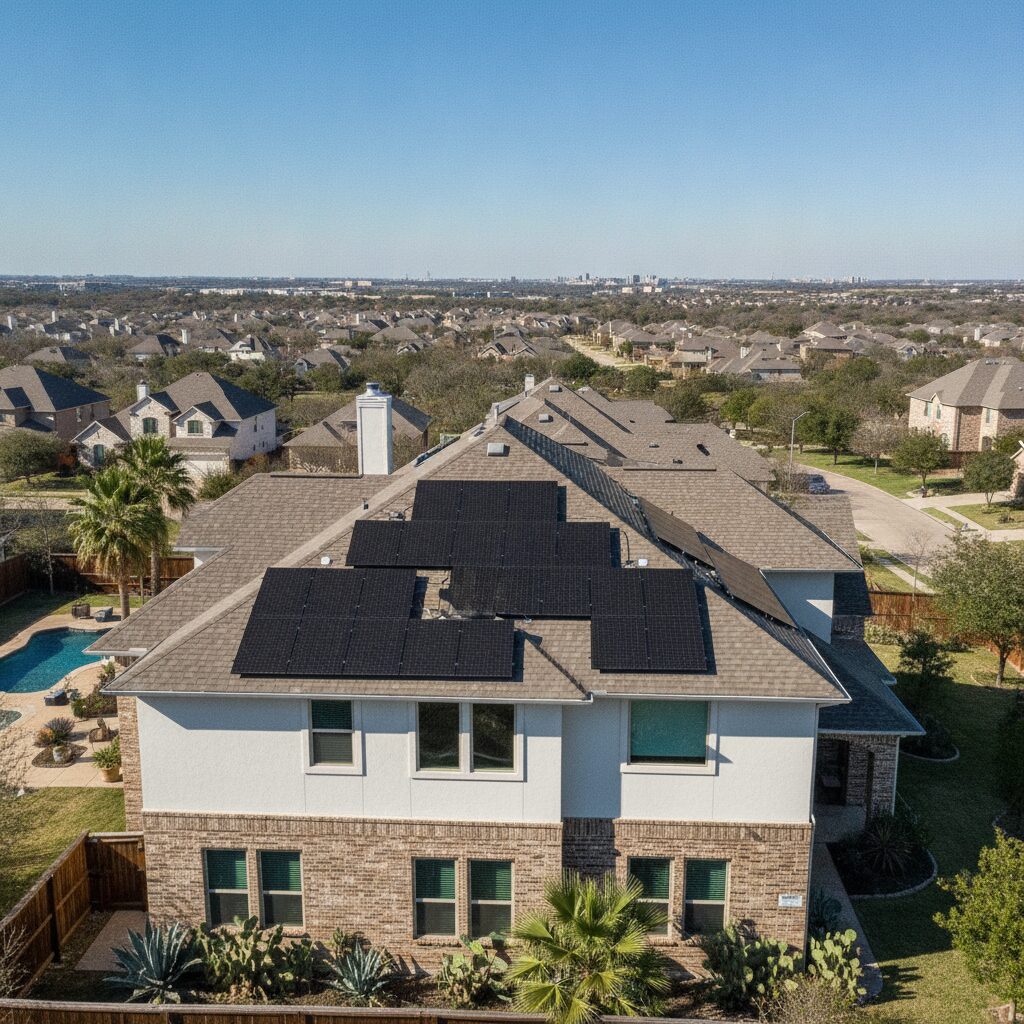
Solar salespeople will quote any roof. Not every roof deserves to be quoted. Here’s how orientation shifts production in Texas latitudes (roughly 29–33°N), assuming a 25–30° pitch and no shading:
| Roof face | Production vs. optimal south | Verdict for Texas ROI |
|---|---|---|
| Due south | 100% | Always yes |
| Southwest | 96–98% | Yes — actually better on TOU rates |
| Southeast | 94–96% | Yes |
| Due west | 85–88% | Yes, especially with battery or TOU |
| Due east | 82–85% | Marginal — depends on utility |
| Northwest/Northeast | 68–75% | Only fill panels if south is full |
| Due north | 55–65% | Skip unless heavily discounted |
West-facing panels are underrated in Texas. Peak grid demand hits 4–7 p.m. in summer, which is exactly when a west array is dumping power. If you’re on a time-of-use rate with CPS or an ERCOT-indexed plan, west can beat south on dollar terms even though it produces fewer kWh.
North-facing panels almost never make sense at Texas latitudes. If an installer quotes you north-face panels to “meet system size,” push back and ask what the marginal panel actually produces. Below about 75% of nameplate, you’re paying full installation cost for partial output.
Shading is worse than orientation
A 15% shade loss from a single pecan tree over your south array will hurt your production more than reorienting the whole system east. Get a shade report (Aurora, HelioScope, or a drone-based Scanifly report) before you sign. Any installer who can’t produce one is guessing.
Real quotes from four Texas cities (October–December 2025)
These are anonymized but real quotes on similar-sized homes, pulled from homeowner submissions and installer bid sheets:
- Austin, 78745 — 8.4 kW, Q Cells 400W, Enphase IQ8M, $22,800 gross / $13,460 net after 30% credit and $2,500 AE rebate. Payback: 6.8 years.
- San Antonio, 78230 — 9.2 kW, REC Alpha 410W, Enphase IQ8+, $26,100 gross / $14,070 net after credit and $4,200 CPS rebate. Payback: 6.4 years.
- Plano, 75024 — 10.5 kW, Silfab 410W, SolarEdge HD-Wave, $27,300 gross / $16,610 net after credit and $2,500 Oncor rebate. Payback: 9.2 years on Rhythm Simply Solar.
- Katy, 77494 — 11.2 kW, Longi 425W, Sol-Ark 12K hybrid + 13.5 kWh battery, $38,400 gross / $26,880 net after credit only. Payback: 12.8 years on Reliant Simple Solar Sell Back.
The Katy quote illustrates a common pattern in Houston: bigger systems, batteries added to compensate for weaker export credits, and payback that runs past a decade. It still pencils out if you plan to stay in the house 15+ years — but that’s a big “if.”
What actually kills solar ROI in Texas
After reviewing hundreds of quotes, the same four issues explain most of the bad-outcome projects:
- Financing at 8%+. A 25-year solar loan at 8.99% adds roughly $11,000 in interest to a $20,000 system. That interest usually equals or exceeds the tax credit. Cash or HELOC beats dealer financing almost every time.
- Oversizing. Utilities in Texas don’t pay retail for excess above your annual usage. Sizing to 120% of consumption is a gift to the grid.
- Skipping the roof age check. If your composition shingle roof is 12+ years old, replace it first. Pulling and reinstalling panels later runs $3,000–$5,000.
- Signing without a shade study. Salespeople quote nameplate. Trees, chimneys, and vent stacks eat production year-round.
Tracking these details is exactly the kind of thing a good home inventory system handles well — panel serials, inverter warranties, monitoring logins, and roof replacement dates all belong in one place, not scattered across email threads.
Should you go solar in 2026 or wait?
Go in 2026 if: you’re in CPS or Austin Energy territory, you have a south/west-facing roof under 10 years old, you can pay cash or use a HELOC under 7%, and you plan to stay 8+ years.
Wait — or skip — if: you’re in CenterPoint territory without a strong REP buyback plan, your roof faces north/east primarily, you’d need dealer financing above 8%, or you’re likely to sell within five years. The 30% credit matters, but a 14-year payback in Houston with an 8.99% loan isn’t rescued by any tax credit.
The window that closes at the end of 2026 is real, but not every Texas homeowner should sprint through it. Run the numbers on your specific utility, roof, and financing before you sign — the difference between a 7-year and a 12-year payback is almost always visible in the quote if you know where to look.