
Your Home Is a $500K Business. Why Are You Running It on Sticky Notes?
Imagine walking into the office of a CEO who runs a half-million-dollar operation. Fifty-plus active vendors. Hundreds of assets on the balance sheet. Recurring service contracts. A small fleet of vehicles. An annual operating budget north of $30,000.
Now imagine she’s running all of it from a junk drawer.
A receipt from the HVAC guy from 2022, paper-clipped to a manual for an oven that’s been replaced. A sticky note on the fridge with the lawn guy’s number-first name only, no idea if he’s still in business. A photo somewhere on her phone of the serial number on the washing machine, taken because she “might need it for the warranty,” which expired eight months ago. A bookmark folder labeled plumbers?? with four tabs, none of which she’s ever clicked.
This is, statistically, how you run your home.
And your home is a business. A bigger one than you think.
The Balance Sheet You’ve Never Drawn Up
Pull the numbers on a typical American homeowner and the picture is genuinely staggering.
The asset itself. The median U.S. home value is hovering north of $400,000. In most metros, it’s the single largest thing the household will ever own.
The inventory inside it. Insurance industry research consistently puts the contents of an average three-bedroom home between $50,000 and $80,000 appliances, electronics, furniture, tools, sports gear, kids’ stuff, the slow accretion of a decade of Amazon orders.
The vehicles. Average household: 1.8 cars. Add another $30,000–$50,000.
The annual operating budget. Property tax, insurance, utilities, internet, lawn care, pest control, HVAC servicing, plumber visits, appliance repairs, cleaners, handymen. For a typical homeowner this comes in somewhere between $15,000 and $35,000 a year before a single major project.
Add it up and you’re easily looking at half a million dollars in assets and tens of thousands a year in operating spend. That’s not a household. That’s a small business.
The problem is, nobody runs it like one.
The Sticky-Note Stack
Here’s how the average household actually manages this empire today:
A Gmail folder called receipts that’s never been opened twice. A Notes app entry titled MOVERS NUMBER!! from 2019. A camera roll containing 47 pictures of warranty cards, model numbers, and damage from a leak that may or may not have ever been claimed. A spouse who knows the wifi guy’s name. A spouse who does not. Three different apps for booking three different kinds of services, each with its own login, its own payment method, its own forgotten password. A garage full of stuff that is technically worth several thousand dollars on the resale market and will eventually be donated, dumped, or left for the next owner.
This isn’t a personal failing. It’s the natural result of trying to manage a business with consumer tools.
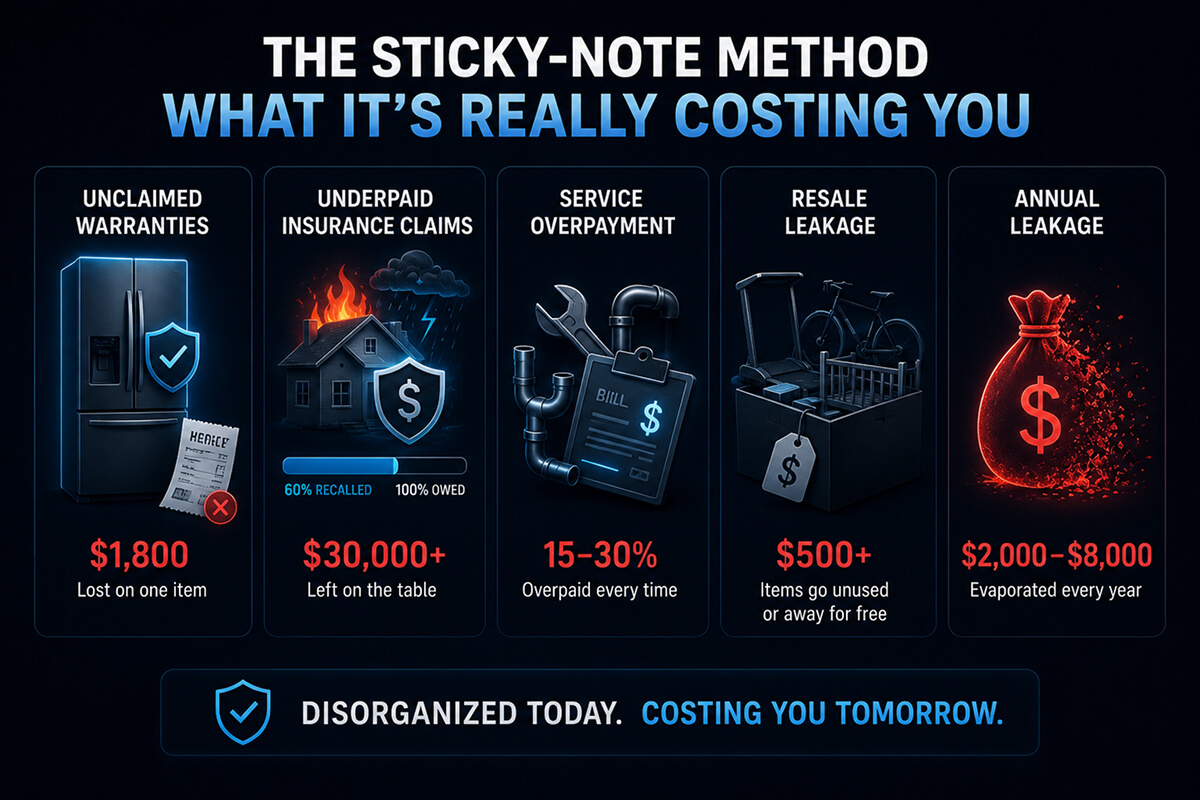
What the Sticky-Note Method Actually Costs
The cost of this disorganization isn’t theoretical. It’s measurable, and it’s much higher than people realize.
Unclaimed warranties. Industry estimates suggest fewer than 20% of eligible appliance warranty claims are ever filed. The product breaks, the receipt is gone, the registration was never completed, and the homeowner just buys a new one. On a single $1,800 fridge, that’s a $1,800 mistake.
Underpaid insurance claims. When a fire, theft, or flood happens, insurers pay what you can prove you owned. Without an inventory, most homeowners recall maybe 60% of their actual contents under stress. On a major claim, that’s the difference between recovering $50,000 and recovering $80,000.
Service overpayment. Without a record of what you paid the last plumber, you have no leverage with the next one. Without reviews tied to your own past bookings, you’re rolling the dice on Yelp and Nextdoor every time. Most homeowners overpay by 15–30% on routine services simply because there’s no friction-free way to compare.
Resale leakage. That treadmill in the basement is worth $400. The crib in the attic, $250. The bike nobody rides, $300. Most of this never gets listed, because listing is a chore-photograph, write copy, post on three platforms, field lowballers, repeat. So it sits, and eventually leaves the house for free.
The honest accounting on a typical year: somewhere between $2,000 and $8,000 in pure leakage. Money that was yours, that simply evaporated because there was no system.
The Shift: From Junk Drawer to Home OS
Every other category of complex personal logistics has been swallowed by software in the last fifteen years. Money got Mint, then Rocket Money. Travel got Hopper and TripIt. Scheduling got Calendly. Even your subscriptions got their own dedicated apps.
But the home-the largest, most complex, most expensive operation most people will ever run-has stayed weirdly fragmented. Buy on Facebook Marketplace. Sell on OfferUp. Book a plumber on Thumbtack. Track a warranty on the manufacturer’s website (if you can find it). Inventory your stuff on a spreadsheet you’ll never update. Real estate on Zillow. Cars on Autotrader. Movers on Yelp.
Eight tools, eight logins, eight learning curves, zero integration.
What’s been missing is a home OS. A single layer that holds the inventory, the documents, the contacts, the bookings, the listings-and the agent intelligence to actually do something with all of it.
What “Running It Like a Business” Actually Looks Like
The shift sounds bigger than it is. In practice, it comes down to four moves.
1. Get your inventory on the books.
Every appliance, electronic, piece of furniture, and significant item should exist as a record somewhere-model, serial number, purchase date, warranty status, photos. This is the single highest-ROI thing a homeowner can do, and the one almost nobody does. With AI-assisted entry, what used to take a full weekend now takes a long evening.
2. Centralize your vendor relationships.
The plumber who fixed your sink last March is an asset. So is the cleaner you trust, the HVAC tech who knows your system, the landscaper who knows where the irrigation line runs. Treat these like vendor accounts, not like phone numbers your spouse might remember.
3. Make selling frictionless.
The reason your garage is full is not that you’re sentimental-it’s that listing is annoying. Photo-to-listing AI changes the math: snap, generate, post. When the friction drops below the value of the item, things actually move.
4. Put one assistant on top of all of it.
The point of consolidation isn’t to make you do more work in one place. It’s so an AI agent can finally see across your home and act on your behalf-flagging warranties about to expire, suggesting it might be time to sell the kayak you haven’t used in two summers, surfacing the fact that three of your last four service bookings were emergencies and that maybe a maintenance schedule would help.
This is the actual unlock. Not a better app. A single map of the territory, so software can finally help.
Where HomeShow.ai Fits
This is the system we built.
HomeShow.ai is a single platform where your inventory (HomeVault), your service bookings, your marketplace listings, your warranties, your vehicle records, and your real estate live together with an AI assistant called Homie sitting on top, watching for the things you’d otherwise miss.
You can list a couch in under a minute with photo-to-AI tools. You can book a vetted local pro with a live calendar and a price you can see before you commit. You can track every appliance you own-with the warranty clock ticking visibly, not silently. You can ship a piece of furniture across the country through integrated logistics. You can sell a car, rent out a backyard for an event, or list your house, all from the same account.
It’s ad-free. The fees are low and transparent. The point is not to monetize your attention; it’s to give your home the operating layer it has always deserved.
We’re live in Texas now, with the rest of the country coming online through 2026.
You’re Already Running the Business. Run It on Purpose.
The choice isn’t whether to manage your home like a business. You already do. You’re already paying the bills, hiring the vendors, buying the assets, accumulating the inventory.
The only question is whether you’re doing it intentionally-with leverage-or by accident, with sticky notes.
The sticky notes have a cost. It’s larger than you think. And the alternative is no longer a fantasy productivity system you’ll set up over a long weekend and never maintain. It’s an AI doing most of the work for you, in the background, on a single platform.
The half-million-dollar business in your house deserves better than a junk drawer.
It’s time to give it one.
Ready to stop running your home on sticky notes? Download HomeShow.ai and set up your HomeVault in under ten minutes. Available now in Texas; nationwide rollout throughout 2026.