
Booking a Cleaner for Short-Term Rental Cleaning in Texas: A Host’s Playbook
For short term rental cleaning in Texas, book a cleaner who can complete a full turnover in the 4–5 hour window between an 11 a.m. checkout and a 4 p.m. check-in, handles linens on-site or via a swap service, restocks consumables from a host-supplied closet, and sends timestamped photos when the job is done. That’s the whole job in one sentence. Everything below is how to actually get that result without paying for a redo, losing a five-star review, or scrambling at 3:30 p.m. when a guest is already in the driveway.
If you host in Austin, Dallas, Houston, San Antonio, or any Hill Country town with summer demand spikes, the cleaner you book is the single most leveraged hire on your P&L. Get it right once and you’ll repeat the same booking for 100 turnovers.
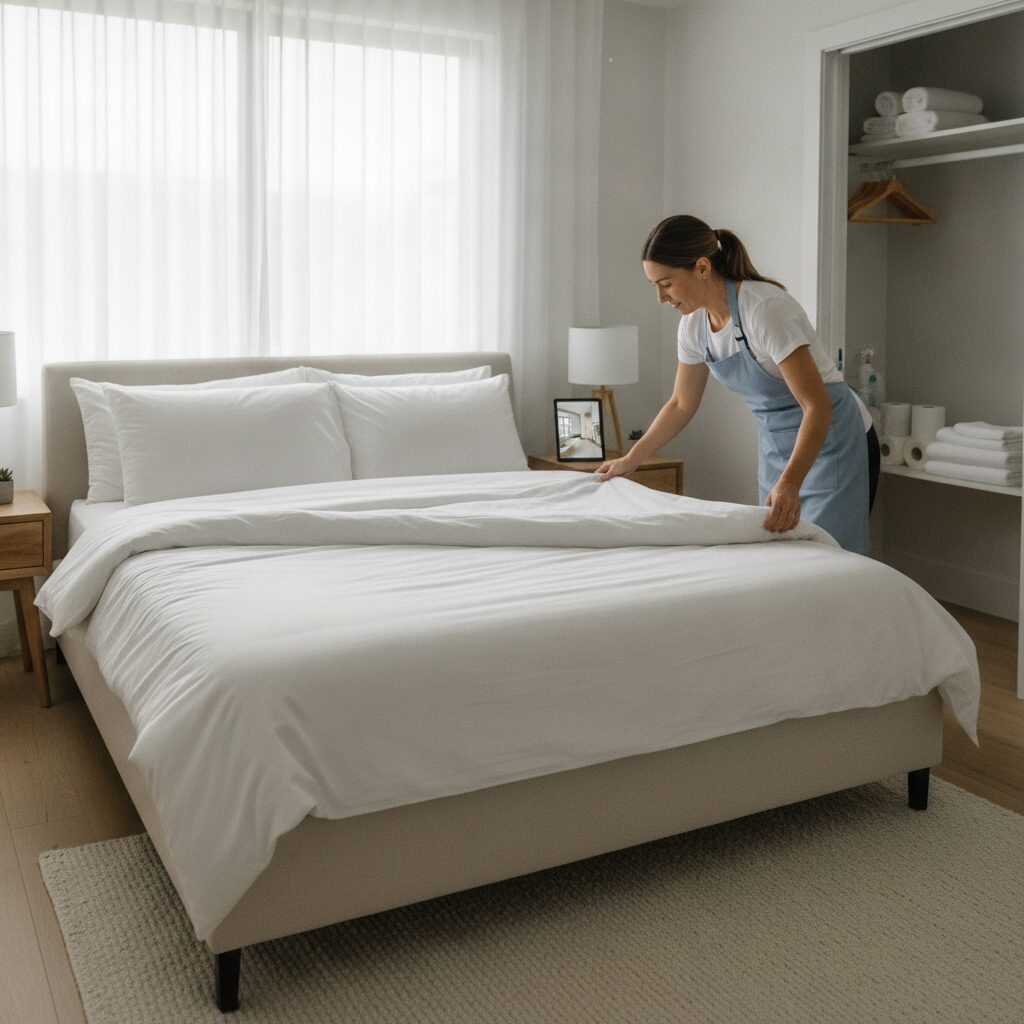
What a Texas STR turnover actually involves
A turnover is not a “deep clean.” It’s a reset. The property needs to look, smell, and function exactly like it did the day you photographed it for the listing. That includes things a residential cleaner wouldn’t normally touch: checking that the Wi-Fi router has power, that the propane tank on the grill isn’t empty, and that no guest left a half-eaten brisket in the fridge.
A standard 2-bed, 2-bath turnover in Texas usually breaks down like this:
- Bathrooms (45–60 min): Toilets, showers, mirrors, restocking toilet paper and amenities.
- Kitchen (45–75 min): Dishwasher load/unload, counters, appliance wipe-down, fridge check, trash out.
- Beds and linens (30–45 min per bed): Strip, remake with fresh sets, check mattress protectors for stains.
- Floors and surfaces (45 min): Vacuum, mop, dust ceiling fans (critical in summer when they run 24/7).
- Final walk-through (15 min): Photos, restock log, AC set to 72°F, blinds positioned, welcome note placed.
Total: roughly 3.5 to 4.5 hours for two people, or 5 to 6 hours for a solo cleaner. If your check-in is at 4 p.m. and checkout is at 11 a.m., a solo cleaner has almost no buffer. A two-person team is the realistic floor for anything bigger than a studio.
Pricing benchmarks for short term rental cleaning in Texas
Cleaner pricing in Texas has crept up since 2022, but it’s still cheaper than coastal markets. Here’s what hosts are paying as of this year:
| Property type | Austin / Hill Country | Dallas / Houston | Smaller metros |
|---|---|---|---|
| Studio / 1BR | $75–$110 | $65–$95 | $55–$80 |
| 2BR / 2BA | $120–$165 | $100–$140 | $85–$120 |
| 3BR / 2BA | $160–$220 | $140–$190 | $115–$160 |
| 4BR+ or pool home | $240–$400+ | $200–$320 | $170–$260 |
Charge the cleaning fee to the guest at booking. Most Texas hosts mark it up 10–15% to cover the consumables (coffee pods, paper towels, dish soap) that the cleaner restocks but doesn’t supply. Don’t try to hide the fee in the nightly rate — Airbnb and Vrbo both surface it before booking now, and a $150 cleaning fee on a 2-night stay reads worse than the same fee on a 4-night stay, so adjust your minimum stay accordingly.
The turnover timing math nobody explains
The 11-to-4 window is not five hours of cleaning time. It’s the outer envelope. Real available cleaning time looks like this:
- 11:00 a.m. — Checkout time. Roughly 20% of guests leave late. Assume 11:20.
- 11:20–11:40 — Cleaner drives to property, parks, hauls in supplies and linens.
- 11:40–3:30 — Actual cleaning work. ~3 hours 50 minutes.
- 3:30–3:45 — Final photos, lockup, drive away.
- 3:45–4:00 — Buffer for the inevitable spill, broken glass, or “guest left their suitcase” call.
If your cleaner is also doing laundry on-site, add 90 minutes of overlap — washing sheets while cleaning bathrooms only works if you have a stacked washer/dryer that runs a 45-minute cycle. Texas summer humidity means towel cycles often need a second dryer run. Two-set linen rotation (one set on the bed, one washed and ready) is the single biggest time-saver, and it costs less than one missed turnover.
Linens: own two sets, or use a swap service
You have three real options for linens, and the wrong one will sink you.
Option 1: On-site laundry, single set
Cheapest, slowest, riskiest. One wine stain and the bed isn’t ready. Only viable for properties with same-day-checkout-only rules and a generous turnover window.
Option 2: On-site laundry, two or three sets
The sweet spot for most Texas hosts. Buy three sets of white sheets (white bleaches; patterns fade). Budget $80–$120 per bed for hotel-grade percale or sateen. Same for towels — three sets per bathroom, all white, all the same brand so replacements match.
Option 3: Linen swap service
Available in Austin, Dallas, and Houston through companies that drop off clean sets and pick up dirty ones. Runs $4–$8 per sheet set and $1.50–$3 per towel. Worth it for properties without on-site laundry, or for hosts running 4+ units who don’t want to manage linen inventory. Your cleaner just swaps the bag.
Whichever you pick, write it into the booking request. A cleaner who shows up expecting Option 3 and finds Option 1 will either leave or charge you a same-day surcharge.
The restocking closet — and the supply list your cleaner needs
Build a locked closet or labeled bin the cleaner can access on every visit. Inside, keep par levels of every consumable. The cleaner restocks to par and texts you when anything is below the reorder threshold.
A minimum Texas STR supply list:
- Bathroom: Toilet paper (4 rolls per bathroom, plus 2 spare), shampoo/conditioner/body wash refills, hand soap, makeup-remover wipes, extra toothbrush.
- Kitchen: Dish soap, dishwasher pods, sponges, paper towels, trash bags (both kitchen and outdoor sizes), coffee pods or grounds, filters, salt/pepper, cooking oil, sugar packets.
- Bedrooms: Extra pillows in closet, spare blanket, phone charger (cheap USB-C and Lightning).
- Outdoor (if applicable): Bug spray, sunscreen, propane check tag, pool towels for pool homes.
- Cleaning closet: Vacuum bags/filters, mop heads, all-purpose cleaner, bleach, microfiber cloths, a spare HVAC filter.
That last one matters in Texas. Your HVAC filter clogs in 30–45 days during summer cottonwood season. A cleaner who can swap a 1-inch filter when the old one’s gray saves you a $180 service call.
Vetting a cleaner on a booking marketplace
When you’re scrolling profiles on HomeShow.ai or a similar local services platform, the listing photo and price tell you almost nothing. Here’s what actually predicts a good turnover cleaner.
Filter signals to trust
- STR experience specifically. Residential maid service experience does not transfer cleanly. Ask: “How many Airbnb turnovers did you do last month?” A real STR cleaner answers in seconds.
- Reviews that mention specific properties or hosts. Generic “great job!” reviews are noise. “Cleaned our 3BR in Bouldin for 18 months, never a complaint” is signal.
- Same-day responsiveness. Send a booking inquiry at 9 a.m. The cleaners who respond inside two hours are the ones who’ll respond when a guest finds a hair in the shower at 4:15 p.m.
- Photo documentation as standard. A cleaner who offers timestamped photos of every turnover without being asked is operating professionally.
- Insurance. General liability of at least $1M. A broken TV is a $700 conversation that goes much smoother when there’s a policy behind it.
Red flags
- Cash-only. Means no tax records, often no insurance, and no way to dispute a job.
- Refuses to do a walk-through before the first booking.
- Won’t share a sample turnover checklist.
- Quotes the same flat rate regardless of square footage or bed count.
- Vague on linen handling. This is the question that separates pros from hobbyists.
The first booking: do a paid walk-through, not a free estimate
Pay the cleaner for 60–90 minutes to walk the property with you before any guest ever stays. Show them:
- The supply closet and par levels.
- Where linens live and how laundry runs.
- Your photo standards (snap reference shots of how the bed is staged, where remotes go, how the throw is folded).
- The lockbox or smart lock code and how it rotates.
- Quirks: the kitchen faucet that drips, the back door that sticks, the smoke alarm that beeps every June.
This $50–$100 spend is the single best protection against the first-turnover disaster. It also tells you whether this cleaner asks good questions or just nods.
Communication during the turnover
Set up exactly three communication touchpoints, in writing, in the booking confirmation:
- Arrival ping. Cleaner texts a thumbs-up when they’re on-site. You now know the clock has started.
- Damage/issue flag. Any broken item, suspicious stain, or missing inventory triggers a photo + short description before the cleaner moves on. Don’t wait until the end.
- Completion photos. A standard set: each made bed, each bathroom counter, the kitchen, the living room from the same angle every time. Stored in a shared folder by date.
That third one is your defense when a guest claims the place was dirty on arrival. Time-stamped photos resolve 90% of cleaning-fee disputes on the platform side.
Building a backup bench before you need one
Your primary cleaner will get sick, take a vacation, or quit during a long July weekend. Have two backup cleaners pre-vetted and pre-walked-through before peak season. Pay each of them for one off-peak turnover so they know the property. The cost of three pre-season backup jobs ($400 or so) is less than one canceled booking and a one-star review.
Booking marketplaces make the bench easier to build because you can keep multiple vendors saved, message all three in parallel during an emergency, and see real-time availability instead of leaving voicemails. Use that. The host who treats cleaning like a single-vendor dependency is the host who eventually eats a refund.
What this looks like 12 months in
A Texas STR running 70% occupancy does roughly 80–100 turnovers a year. At $130 per turnover, that’s $10,000–$13,000 flowing through this one vendor relationship. Treat it accordingly: written checklist, agreed pricing tiers for stay length, a holiday surcharge schedule (Christmas Eve and New Year’s Day both cost extra, agree on the number in February, not December 23rd), and an annual rate review.
The hosts who run profitable Texas short-term rentals aren’t the ones with the prettiest listing photos. They’re the ones whose cleaners answer the phone on the first ring.