Rent Photography Studio Austin: Rates, Rules & How to List Your Space
If you want to rent a photography studio in Austin, expect to pay between $35 and $150 per hour depending on size, natural light, and props. Most hosts require a two-hour minimum, a refundable damage deposit of $200–$500, and proof of liability insurance for any shoot involving more than three people or any commercial use. On the host side, a clean 600–1,200 sq ft loft in East Austin can realistically pull $1,800–$4,500 per month in part-time rental income once it’s listed properly and reviewed a few times.
Below is what the Austin market actually looks like right now — the rate bands, the contract norms, what renters check before booking, and a practical path for garage and loft owners who want to list space without quitting their day job.
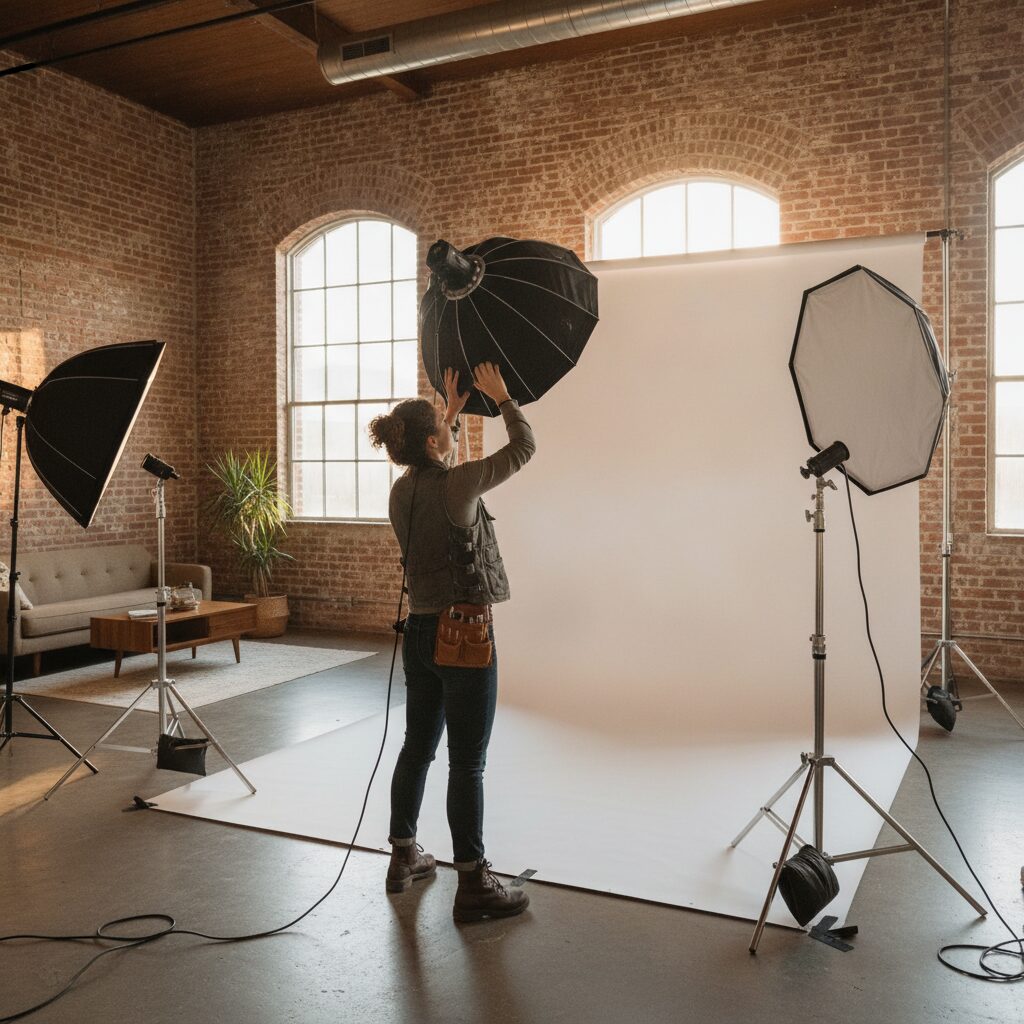
What it costs to rent a photography studio in Austin
Pricing in Austin clusters into three tiers. The differences come down to ceiling height, window direction, square footage, and whether the host throws in equipment.
| Tier | Hourly rate | Typical space | What’s included |
|---|---|---|---|
| Budget | $35–$60 | Converted garage, small home studio, 300–500 sq ft | One backdrop, basic lighting, Wi-Fi |
| Mid-market | $65–$110 | East Austin loft or warehouse bay, 600–1,200 sq ft | Multiple backdrops, two strobes, modifiers, props, kitchen |
| Premium | $120–$250 | Daylight studios in the Domain or South Lamar, cyc walls, 1,500+ sq ft | Full grip, makeup station, parking, dressing room |
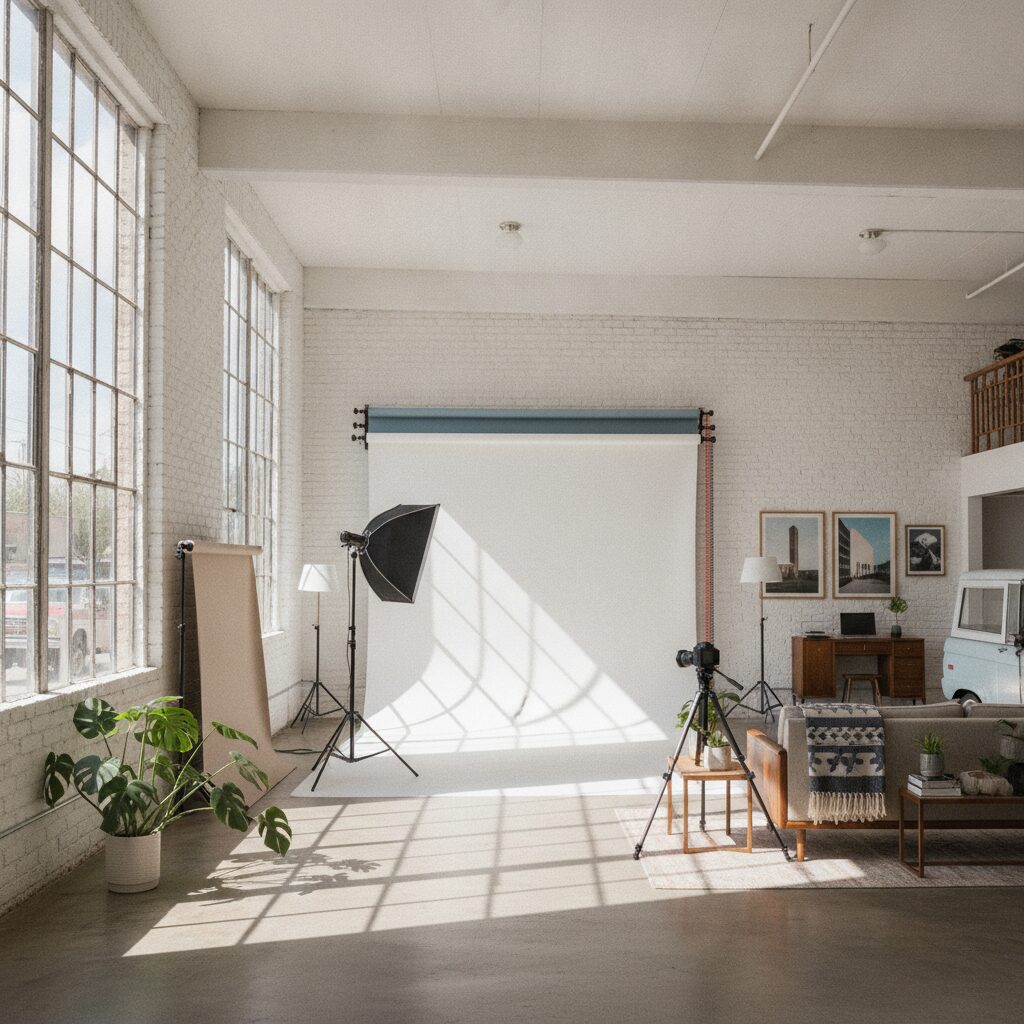
North-facing windows command a premium. A 900 sq ft space on East 6th with steady north light books for roughly 30% more than the same square footage with harsh west exposure. Cyclorama walls (those seamless curved white corners used for product and fashion) add another $20–$40 per hour because of the maintenance — they get repainted every 10–15 sessions.
Two-hour minimums are universal. Four-hour minimums apply on weekends at most premium spaces. Overtime is usually billed at 1.25× the hourly rate, rounded up to the nearest 30 minutes.
Deposits, cleaning fees, and the fine print
The deposit norm in Austin sits at $250 for mid-market spaces and $500 for premium. It’s almost always refundable within 5–7 business days assuming no damage and no overtime. A few hosts skip the deposit entirely if the booking platform holds a payment method on file with authorization to charge for damages.
Cleaning fees are separate and non-refundable. Expect $40–$75 for a standard shoot, $100–$150 if the booking involves food, pets, glitter, or smoke machines. One host I spoke with in the Mueller area charges an automatic $200 if confetti is used without prior approval. She’s had to mop it out of HVAC vents twice.
Other line items that show up regularly:
- Equipment rental add-ons: $15–$30 per strobe, $10 for a C-stand, $25 for a beauty dish.
- Parking validation: $5–$15 per car in central Austin spaces.
- After-hours fee: $25–$50 added to bookings starting before 8 a.m. or ending after 10 p.m.
- Crew cap: Most listings cap attendance at 8–12 people. Over that, you pay $5–$10 per additional person per hour.
Insurance: what hosts require and what renters actually carry
Any commercial shoot in Austin should expect to provide a Certificate of Insurance (COI) listing the host as additionally insured. The standard ask is $1 million general liability. Hosts running fully licensed studios won’t budge on this. Casual hosts renting out a converted garage often waive it for solo portrait shoots but require it for anything with paid models, lighting on stands, or product on consignment.
Photographers usually carry one of three things:
- An annual policy from providers like Hill & Usher or Athos. Runs $400–$900 a year for a $1M policy. Worth it if you shoot more than 10 times a year.
- Short-term event insurance through The Event Helper or Thimble. Around $12–$30 per shoot day.
- Platform-provided coverage bundled into the booking fee. This is becoming standard on marketplace-style listings and typically covers $1M in liability and a few thousand in property damage automatically.
If you’re a host, don’t accept a screenshot of a policy declarations page as proof. Ask for a current COI with your name and address listed. It takes the renter’s broker about 10 minutes to issue one.
What renters look at before they book
Photographers and content creators booking Austin studios filter aggressively. After watching several hundred bookings on marketplace platforms, the pattern is clear:
- Window direction and time of day. Listings that specify “north light, peak window 9 a.m.–2 p.m.” book 3× faster than ones that just say “great natural light.”
- Ceiling height. Anything under 10 feet limits boom lighting and full-body fashion work. Hosts who measure and list this get more serious bookings.
- Sample photos shot in the space. Not real estate photos. Actual portraits, product, or editorial work done there. Bonus if you tag the photographer.
- Parking and load-in. A second-floor walk-up with no elevator near downtown will lose to a ground-floor space in East Austin every time, even at a higher rate.
- Cancellation policy. Flexible 48-hour cancellations beat strict no-refund policies, especially for newer photographers testing spaces.
Reviews matter more than the listing copy. Five honest reviews beat a beautifully written description with none. Hosts who comp the first booking in exchange for an honest review usually break even within their first 60 days.
How garage and loft owners can list their space
If you own a detached garage, a finished basement, an underused warehouse bay, or a loft with good light, listing it as a photography studio is one of the lowest-friction ways to monetize square footage in Austin. The work is mostly upfront. After that, a well-priced space averages 8–20 bookings a month with maybe two hours per week of host time.
Step 1: Audit the space honestly
Walk in at three different times of day with your phone camera. Note the light. Measure the ceiling, the floor dimensions, and the largest clear wall. If you have a 12-foot ceiling, a 15-foot clear wall, and a north-facing window, you have a real product. If you have a 7.5-foot popcorn ceiling and a single west window, you have a portrait space best priced under $50/hour.
Step 2: Make three cheap upgrades
- Paint one wall pure white (Sherwin-Williams Extra White, eggshell). Roughly $80 in materials. Doubles your listing’s usefulness.
- Add two backdrops on a crossbar — one white muslin, one neutral canvas. $120 from B&H.
- Cover overhead fluorescents with diffusion or swap them for 5000K LED panels. Mixed color temperature kills shoots faster than anything else.
Skip the strobes at first. Most photographers bring their own. Offering lighting becomes worthwhile once you’ve had five paid bookings and know what people actually ask for.
Step 3: Write a listing that filters for good guests
Be specific. Instead of “great for photoshoots,” write: “12-ft ceilings, north-facing 8×6 window, peak light 10 a.m.–1 p.m., 14×18 ft of clear floor, concrete polished, two outlets per wall, no smoke or open flame.”
That paragraph does three things: it ranks better in search, it pre-qualifies serious renters, and it eliminates the people who’d be disappointed. Pair it with 12–15 photos shot during peak light, plus one floor plan sketch (a phone app like magicplan does this in five minutes).
Step 4: Price for the first ten bookings, not the long run
List 20% under the comparable rate for the first 60 days. A space that would eventually charge $85/hour should launch at $65. The goal is reviews, not revenue, for the first batch. Once you have eight to ten reviews averaging 4.7 or higher, raise the rate in $5–$10 increments and watch the booking velocity.
Tax, zoning, and the boring legal part
Short-term commercial use of residential property is a gray area in Austin. If you’re renting a detached garage on a residentially zoned lot for occasional photo shoots, the city generally treats it like a home occupation — fine as long as it doesn’t generate traffic, signage, or noise that disturbs neighbors. If you’re running a dedicated studio in a commercially zoned space, get a Certificate of Occupancy that reflects the use.
Income from studio rentals is reportable. Most hosts treat it as Schedule E rental income if it’s purely space rental, or Schedule C if they’re providing significant services (equipment, makeup station, staffing). Talk to a CPA who handles short-term rentals — the structure matters more than the dollar amount in your first year.
Hotel occupancy tax does not apply to photography studio rentals in Texas. That’s a common worry from new hosts that you can put aside.
The Austin-specific quirks
A few things that come up in this market and not others:
- SXSW and ACL weeks swing demand wildly. Premium studios book out months in advance at 1.5–2× normal rates. Smaller spaces sometimes sit empty because crews fly in their own.
- Heat. A garage studio without solid AC is unusable from June through September. Renters will leave one-star reviews about the temperature even if the photos came out fine.
- East Austin remains the price sweet spot. South Congress and the Domain command premium rates but face stiff competition. The 78702 and 78721 ZIP codes have the best price-to-demand ratio right now.
- Film crews looking for static backdrops will pay 30–50% more than photographers but bring more wear. Charge accordingly and require detailed shot lists in advance.
If you’re a renter, the calendar matters as much as the listing. Tuesday through Thursday mornings are the easiest times to find quality space at the lower end of the host’s rate band. Weekend afternoons in October and March are the hardest.
A quick checklist for both sides
Renters, before you book:
- Confirm ceiling height and window direction in writing.
- Ask for one photo taken in the space within the last 90 days.
- Verify load-in path, parking, and elevator access if needed.
- Have your COI ready or confirm platform-provided coverage.
- Read the overtime and cancellation language twice.
Hosts, before you list:
- Shoot fresh photos during peak natural light.
- Write specs, not adjectives.
- Set a clear damage deposit and cleaning fee.
- Require a COI for any shoot over four people or any paid commercial work.
- Block off two hours between bookings until you’ve run 10 sessions and know the real turnover time.
The Austin photography studio market rewards specificity. Hosts who describe their space honestly and price for reviews early outearn the ones chasing top-of-market rates from day one. Renters who read carefully and bring insurance get welcomed back at the good studios — and the good studios in this city are the ones that quietly book out three weeks ahead.