Move-Out Cleaning Checklist Texas Renters Use to Get Their Deposit Back
If you want your deposit back in Texas, your move-out cleaning checklist needs to cover seven things landlords almost always flag: the oven interior, refrigerator coils and drip pans, blinds, baseboards, bathroom grout, inside cabinets, and patio sliders. Hiring a pro cleaner for a 1-bedroom apartment in Texas typically runs $180–$280, and a 3-bedroom house runs $320–$525. Under Texas Property Code §92.104, your landlord must return your deposit within 30 days of move-out, minus itemized deductions — and “not professionally clean” is one of the most common line items they write.
Below is what Austin, Dallas, and Houston property managers actually look at during a final walkthrough, what they charge back if you skip it, and how to decide whether to DIY or book a pro through a service like HomeShow.ai.
What Texas Law Says About Cleaning and Your Deposit
Texas doesn’t require “professional” cleaning by statute. What it requires is that the unit be returned in the condition it was rented, minus normal wear and tear. The lease is where landlords add teeth. Most standard Texas Association of Realtors (TAR) residential leases include language requiring the tenant to leave the property “clean and free of trash and debris.” Some leases — especially corporate-managed apartments in Austin and the DFW metroplex — go further and specify professional carpet cleaning with a receipt.
Two practical implications:
- Read your lease for the word “professional.” If it says professional carpet cleaning, a vacuumed carpet won’t cut it. You’ll need a receipt from a licensed cleaner.
- Wear and tear is not your problem. A worn traffic path on 4-year-old carpet is wear. A red wine stain is damage. Landlords sometimes blur this line. You don’t have to accept it.
The Texas Property Code §92.109 also lets you sue for three times the wrongfully withheld amount plus $100 and attorney’s fees if a landlord acts in bad faith. That’s leverage worth knowing about.
The Move Out Cleaning Checklist Texas Landlords Actually Use
I’ve reviewed dozens of move-out inspection sheets from property managers across Austin, Round Rock, Plano, and Houston. The line items repeat. Here’s the consolidated list, organized by room, with the deduction amounts I see most often on itemized statements.
Kitchen (the biggest deposit killer)
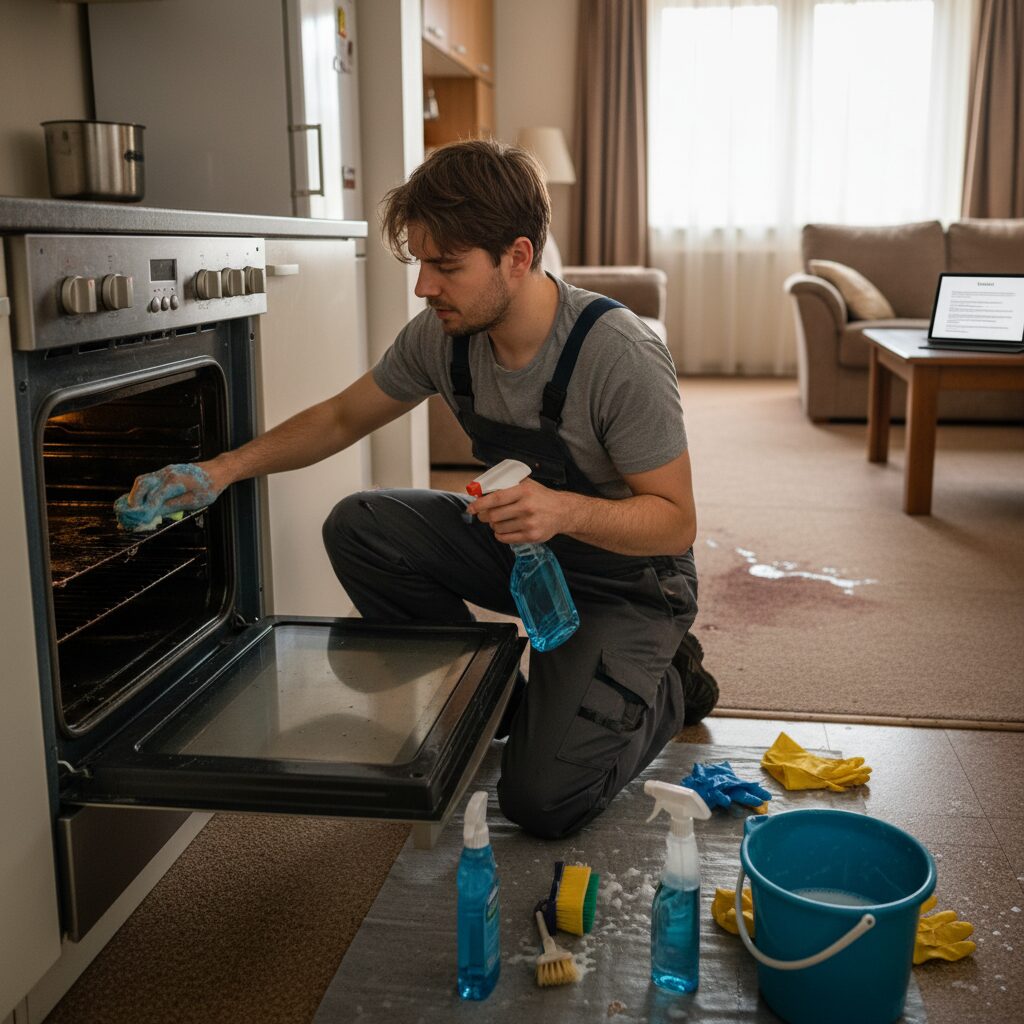
- Oven interior, racks, and broiler pan — grease and baked-on food. Typical deduction: $75–$150.
- Stovetop, drip pans, and burner grates — replace bent or scorched drip pans ($8 each, but they’ll bill $25).
- Range hood filter and exhaust vent — degrease the metal mesh.
- Refrigerator interior, shelves, drawers, and the rubber door gasket — pull it out and vacuum the coils underneath. Mold on the gasket is a $50 charge.
- Inside every cabinet and drawer — crumbs and shelf liner residue. Open them during your own walkthrough.
- Dishwasher filter and door seal — landlords run it during inspection.
- Microwave inside and the turntable — including the ceiling of the microwave, which everyone forgets.
- Backsplash grout and tile — grease film behind the stove.
Bathrooms
- Grout in the shower — mildew here triggers “deep clean” charges of $60–$120 per bathroom.
- Under the toilet rim and the base seal — hard water rings.
- Exhaust fan cover — pop it off and vacuum the dust.
- Mirror, light fixture, and the medicine cabinet inside.
- Caulk lines around the tub — if there’s pink mold, scrub with a bleach paste before you give up and re-caulk.
Living areas and bedrooms
- Baseboards — every single one. Property managers run a finger along them. Dusty baseboards are the #1 cited issue in Austin walkthroughs.
- Blinds — slat by slat. Damaged or yellowed blinds get replaced at $35–$75 per window.
- Window tracks and sills — dead bugs and dirt collect here.
- Ceiling fan blades — dust on top of the blades is visible from below.
- Light switches, outlet covers, and door frames — handprints and scuffs.
- Inside the closet, including the shelf and rod.
- Carpet — vacuum first, then check your lease for professional cleaning requirements.
- Air vents and return grilles — vacuum, don’t just wipe.
Patio, garage, and exterior
- Patio sliders and door tracks — Texas dust accumulates fast.
- Garage floor — oil stains are a common $50–$100 charge.
- Exterior of front door — spiderwebs and wasp nests.
- Mailbox interior — yes, really, in some single-family rentals.
What Pro Cleaners Charge in Texas Right Now
Pricing varies by city and by whether you bundle add-ons. Here’s what I’m seeing on booking platforms across the major Texas metros as of 2025:
| Property size | Austin | Dallas-Fort Worth | Houston | San Antonio |
|---|---|---|---|---|
| Studio / 1-bed apartment | $200–$280 | $180–$260 | $175–$250 | $170–$240 |
| 2-bed / 2-bath | $260–$360 | $240–$340 | $230–$330 | $220–$310 |
| 3-bed house (1,800 sq ft) | $360–$525 | $340–$490 | $320–$470 | $300–$440 |
| 4-bed house (2,600+ sq ft) | $475–$700 | $440–$650 | $420–$625 | $400–$580 |
Common add-ons that aren’t usually included in the base price:
- Interior windows: $4–$8 per window
- Inside fridge: $35–$50
- Inside oven: $35–$50
- Interior cabinets (empty): $40–$75
- Wall spot-cleaning: $60–$120
- Carpet shampoo: $35–$60 per room or $0.30–$0.50 per sq ft
- Garage: $75–$150
A move-out clean almost always costs more than a standard recurring clean — usually 1.5x to 2x — because it includes the interior of appliances, inside cabinets, and baseboards. Don’t book a “standard” clean and expect a move-out result.
DIY vs. Hiring a Pro: When Each Makes Sense
The math is simple. If your deposit is $1,500 and the line items you’d skip add up to a likely $400 deduction, paying $250 for a pro is a $150 net win plus your time back. Most renters underestimate two things: how long deep cleaning actually takes, and how thoroughly a property manager looks.
A realistic timeline for one person deep-cleaning solo:
- Studio: 4–6 hours
- 1-bedroom: 6–9 hours
- 2-bedroom: 9–13 hours
- 3-bedroom house: 14–20 hours
A two-person pro team does a 2-bedroom in about 3–4 hours because they bring commercial-grade degreasers, extension dusters, and a system. If you’re working full-time during move-out week, the calculus tilts hard toward booking it.
DIY makes sense when: the lease is month-to-month with a small deposit, you’re cleaning a studio, or you genuinely enjoy the work. Hire a pro when: your lease requires receipts, the unit has more than one bathroom, or there’s any tile grout, oven grease, or carpet involved.
How to Book a Move-Out Cleaner Without Getting Burned
Booking platforms have replaced the Craigslist-and-Venmo era, but the quality range is still wide. A few rules:
- Specify “move-out clean” in the booking, not “deep clean.” These are priced differently and have different scopes. Move-out clean assumes the unit is empty.
- Confirm the scope in writing. Inside oven, inside fridge, inside cabinets, baseboards, blinds, and window tracks should all be itemized in the quote. If they’re not listed, they’re not included.
- Ask about a re-clean guarantee. Reputable services on HomeShow.ai and similar platforms offer a 24–72 hour re-clean window if the landlord flags something. This is worth more than a $20 price difference.
- Get the receipt with the address and date. If your lease requires professional cleaning, this is your proof. A Venmo screenshot isn’t.
- Book at least 5 days before your final walkthrough. Last-minute bookings cost 15–30% more in Texas markets, and quality drops because every cleaner with availability that day is the one nobody else wanted.
- Be there for the first 15 minutes. Walk the cleaner through anything specific — a stain on the carpet, a sticky drawer, the patio. Then leave them to it.
The 48-Hour Pre-Walkthrough Routine
Whether you DIY or hire out, run this sequence in the two days before your landlord shows up:
- Patch nail holes. Lightweight spackle, 10-minute dry, sand with a damp sponge. Anything bigger than a dime — landlords will charge.
- Replace burned-out bulbs. Landlords charge $8–$15 per bulb plus a service fee. A 4-pack at H-E-B is $6.
- Replace HVAC filter. A fresh filter signals you cared. It’s a $12 move that head-fakes the entire inspection.
- Take date-stamped photos of every room, every appliance interior, and every corner after the clean is done. This is your single best protection if the deposit comes back light.
- Do your own walkthrough with a flashlight. Hold it at floor level along baseboards. Shine it into corners. You’ll find what the property manager is going to find.
- Leave the keys, garage remotes, and mailbox key in an agreed location — and document the handoff.
What to Do If They Withhold Anyway
You have rights and a clock. Under §92.103, the landlord has 30 days from the date you provide a forwarding address. If they keep money, they must send an itemized list of deductions. If they don’t, or the deductions look fabricated:
- Send a written demand letter citing §92.109 and request the full deposit within 14 days.
- Include your photos and your cleaning receipt.
- If ignored, small claims (Justice Court) in Texas handles disputes up to $20,000. Filing fees are $54–$100 depending on county.
- The penalty for bad-faith withholding is 3x the wrongful amount, plus $100, plus attorney’s fees.
Most landlords settle once they see a demand letter with photographic evidence and a cleaning receipt. The few who don’t tend to lose in court.
The Bottom Line for Texas Renters
A thorough move-out clean is the single highest-ROI hour (or $250) you’ll spend on the way out of a Texas rental. Landlords inspect ovens, blinds, baseboards, grout, and cabinet interiors with predictable consistency. Document everything, match your effort to your deposit size, and use the property code as a backstop. Whether you scrub it yourself or book a vetted local pro, the goal is the same: leave nothing on the inspection sheet for them to circle.