How Often Should You Service Your HVAC in Texas? A Practical Schedule
For most Texas homes, the right HVAC service frequency in Texas is twice a year: one full professional tune-up in late winter or early spring to prep the cooling side, and one in early fall for the heating side. Add a filter check every 30 days during summer, every 60-90 days the rest of the year. If you have pets, allergies, or run the system above 75% of the day from May through September-which most Houston, Austin, San Antonio, and Dallas households do-bump filter changes to monthly year-round. Skip this cadence and you will lose roughly 5% efficiency per year of neglect, plus shave two to five years off the compressor’s life.
That is the short answer. The reasoning, the technician’s actual checklist, and why I think summer prep matters more than spring prep is below.
Why Texas Needs a Different Schedule Than the Rest of the Country
National HVAC guidance assumes a system runs hard for three to four months a year. A Texas air conditioner runs hard for six to seven. In Dallas, average cooling degree days exceed 2,800 per year. In Houston, factor in 75-90% summer humidity that loads the evaporator coil and drain pan with biological growth. In the Hill Country and West Texas, dust and pollen coat outdoor condenser fins within weeks of cleaning.
That changes the math. A heat pump in Ohio might log 1,200 cooling hours a season. The same unit in San Antonio logs 2,400 to 3,000. Every component-capacitor, contactor, blower motor, compressor-wears at roughly double the rate. Manufacturer warranties from Trane, Carrier, Lennox, and Goodman require documented annual professional maintenance to remain valid. Some specifically require twice-yearly service for systems in the Sun Belt.
If you ignore that requirement and the compressor fails in year seven, you are buying a $2,800 part out of pocket on a unit you thought was covered.
The Twice-Yearly Professional Tune-Up Schedule
Book these on the calendar the same way you schedule dental cleanings. Demand for HVAC techs spikes in May and October-by then, you are competing with everyone else and paying premium rates.
Late February through early April: cooling system tune-up
Goal: have the AC verified and dialed in before the first 95° day. Texas hits that day anywhere from late March (Brownsville) to mid-May (Amarillo). A tech booked in March can spend 90 minutes on your system. A tech booked in late June, when their phone is ringing every four minutes, will spend 40.
Late September through early November: heating system tune-up
Texas heat is fickle. Houston might see 80° on Christmas. Dallas can drop to 12° in February, as Winter Storm Uri reminded everyone in 2021. A fall tune-up confirms the gas valve, ignitor, heat exchanger, and emergency heat strips (on heat pumps) all work-before the night you actually need them.
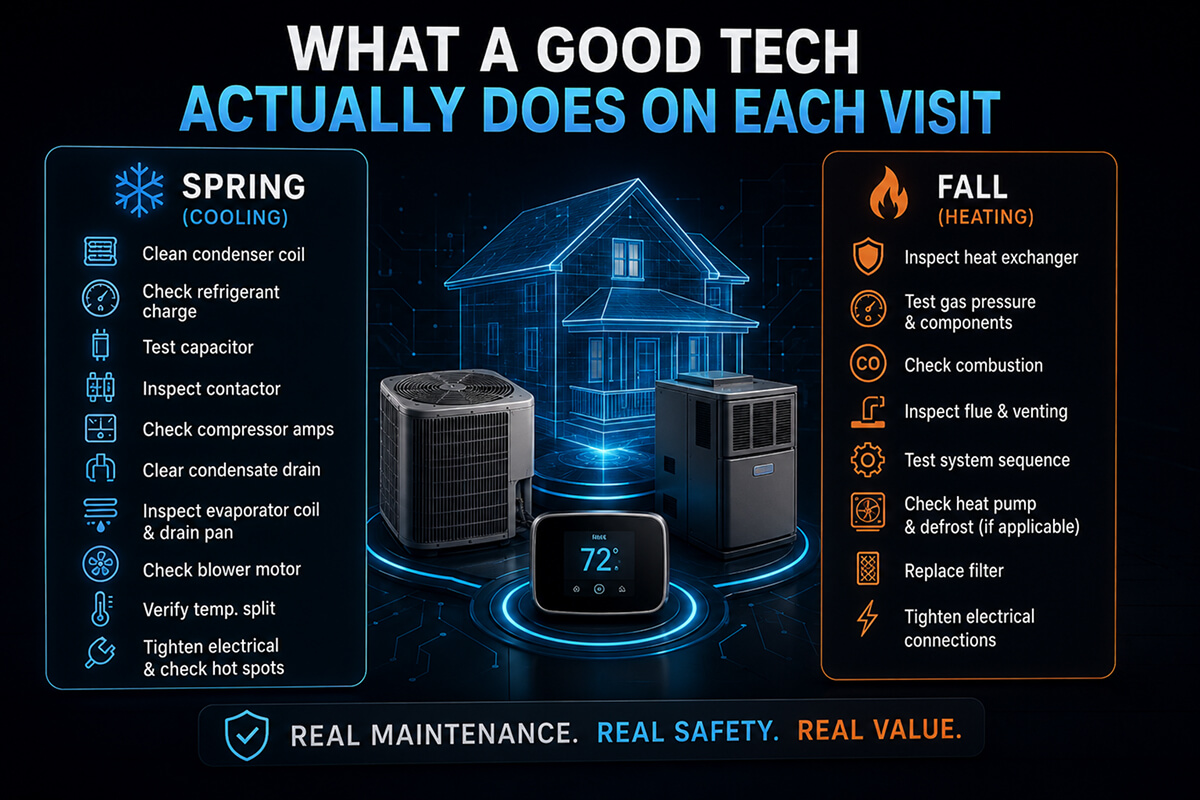
What a Good Tech Actually Does on Each Visit
This is where homeowners get fleeced. A 20-minute “tune-up” for $59 is a sales call, not maintenance. A real spring visit takes 75-120 minutes per system. Here is the checklist you should expect, and you are within your rights to ask for a written copy at the end.
Spring (cooling) tune-up
- Wash the outdoor condenser coil with a coil cleaner and low-pressure water not just a hose rinse
- Check refrigerant charge by measuring superheat and subcooling, not by adding refrigerant “because it looks low”
- Test capacitor microfarads against nameplate rating (a capacitor at 5% below spec is on its way out)
- Inspect contactor for pitting and arc damage
- Measure compressor amp draw and compare to RLA on the data plate
- Clear the condensate drain line with a wet/dry vac and flush with a cup of distilled vinegar
- Inspect and treat the evaporator coil and drain pan for biological growth
- Check blower motor amp draw and wheel cleanliness
- Verify thermostat calibration and supply/return temperature split (should be 18-22°F)
- Tighten electrical connections and check for hot spots with an infrared thermometer
Fall (heating) tune-up
- Inspect heat exchanger with a borescope or mirror for cracks non-negotiable on gas furnaces
- Test flame sensor, ignitor, and gas pressure
- Measure combustion CO and CO2 if the tech has an analyzer (some don’t; insist they do)
- Inspect flue draft and venting
- Cycle the system through a full heating call and watch sequence of operations
- For heat pumps: verify defrost cycle, reversing valve operation, and auxiliary heat strip amperage
- Replace the filter
- Re-tighten electrical connections that may have loosened from summer thermal cycling
If your “tune-up” doesn’t include refrigerant readings on the cooling visit or heat exchanger inspection on the heating visit, you got a discount inspection, not a tune-up. Push back or find someone else.
Why Summer Prep Matters More Than Spring Prep
Here is a contrarian take: the early-spring tune-up gets all the attention, but the visit that actually saves systems is a mid-summer check-in around late July. I know that’s not standard advice. Most contractors won’t sell it because their schedules are packed. But the data backs it up.
By late July, your condenser has pulled four months of cottonwood, mowed grass, dust, and (in East Texas) pine pollen through its fins. Static pressure across the air handler has crept up as the filter and coil load. The capacitor that tested at 45 µF in March may now be at 41 µF after 1,500 hours of 100°+ ambient temperatures cooking it. Refrigerant lines that were properly insulated in spring may have UV-degraded sleeves cracking on the south side of the house.
None of this is visible from the thermostat until the system fails on a Saturday at 4 p.m. when service calls cost $250 just to show up.
A 30-minute mid-summer wellness check-rinse the condenser, recheck the capacitor, vacuum the drain line, replace the filter, verify amp draws-catches the failures that strand families on the hottest weekends. It costs $80-120. It prevents the $1,400 emergency compressor replacement.
Filter Cadence: The Thing You Control
Filter replacement is the single highest-leverage maintenance task, and it’s the one homeowners get wrong most often. A clogged filter raises static pressure, starves the evaporator coil of airflow, drops coil temperature below freezing, and ices the system. I’ve seen Texas homeowners run the same 1-inch fiberglass filter for nine months and wonder why their compressor seized.
| Filter type | Texas summer (May-Sept) | Off-season |
|---|---|---|
| 1-inch fiberglass (MERV 4-6) | Every 30 days | Every 60 days |
| 1-inch pleated (MERV 8-11) | Every 45-60 days | Every 90 days |
| 4-5 inch media filter (MERV 11-13) | Every 6 months | Every 9-12 months |
| Washable electrostatic | Rinse monthly | Rinse every 60 days |
Two adjustments. If you have shedding pets, cut intervals by 30%. If anyone in the home has asthma or moderate-to-severe allergies-common in Austin’s cedar fever season and across the Gulf Coast-use a MERV 11 minimum and check monthly.
A note on MERV ratings: do not jump straight to MERV 13 on an older system. Higher MERV means more resistance, and a 15-year-old blower motor may not have the static pressure headroom. Ask your tech to measure total external static pressure before you upgrade filters. If it’s already above 0.5 inches of water column, a high-MERV filter will make things worse, not better.
Maintenance Plans: Worth It or Not?
Most Texas HVAC companies sell annual maintenance agreements for $180-300 covering two visits. The math works out if-and only if-three conditions are true:
- The plan includes priority scheduling during summer breakdowns (this is the real value)
- Service call fees are waived or discounted for plan members
- You get a written checklist after each visit, not a verbal “everything looks good”
If you pay $240 for two visits that would have cost $260 individually, and you get bumped to the front of the line on a July emergency, the plan paid for itself before you read this sentence. If it’s just a discount on inspections you could schedule yourself, skip it and book à la carte.
Signs You Need Service Sooner Than Scheduled
Wait on the calendar at your own risk if any of these show up:
- The system runs more than 20 minutes to drop one degree on a 95° day
- You hear a hum from the outdoor unit but the fan isn’t spinning (failed capacitor-easy fix if caught early)
- Water around the indoor air handler or stains on the ceiling below it (clogged drain line)
- Ice on the refrigerant lines or evaporator coil
- Energy bills jumped 15%+ year-over-year for the same usage pattern
- Musty smell from the supply vents when the system kicks on
- Short cycling-turning on and off every two to three minutes
Each one points to a specific failure mode. None of them resolve themselves.
What This Actually Costs Per Year
For a typical 2,000 sq ft Texas home with a single 3-4 ton system:
- Two professional tune-ups: $180-300
- Optional mid-summer check: $80-120
- Filters (1-inch pleated, monthly summer / quarterly winter): $80-140
- Coil cleaner and condensate tablets if you DIY between visits: $25
All in: roughly $300-450 per year. Against a $7,000-12,000 system replacement, that’s a 4-6% annual insurance premium on the second-most-expensive appliance in your house. The Texas climate doesn’t punish you for skipping a year. It punishes you for skipping three.
Book the spring visit now if you haven’t. Then put the fall visit on the calendar for the same week in October. The hardest part of HVAC maintenance is remembering to do it.