Selling a Boat in Texas: Title, Sales Tax, and Trailer Registration Explained
To sell a boat in Texas as a private party, you need three documents at signing: the current Texas Certificate of Title (form PWD 143), a completed Bill of Sale (PWD 143M is the TPWD-friendly version), and — if it has one — the separate trailer title issued by TxDMV. The buyer, not you, pays the 6.25% Texas boat sales tax when they file the transfer with Texas Parks & Wildlife within 45 days. Miss that window and they owe a 5% penalty at day 46, jumping to 10% after 60 days. Your job is to hand over clean paperwork and a signed title so the buyer can walk into a TPWD office or file online without a single hiccup.
Below is the full sequence: what to sign, what the buyer pays, how the trailer is treated separately, and how to price against Boat Trader and dealer inventory so your listing actually sells.
What counts as a “boat” under Texas law
Texas Parks & Wildlife (TPWD) titles and registers most motorized vessels and all sailboats 14 feet or longer. If it has a motor — even a trolling motor on a kayak — TPWD wants it titled. Non-motorized canoes, kayaks, paddleboards, and rowboats under 14 feet are exempt. USCG-documented vessels (typically larger cruisers) skip TPWD titling but still need Texas registration if used on state waters.
The hull identification number (HIN) is your VIN equivalent. It’s a 12-character code stamped on the transom’s starboard side. Verify it matches the title before you list. A mismatch — even a transposed digit from a decades-old typo — will stop the transfer cold at TPWD.
The four documents you hand the buyer
Get these ready before anyone shows up with cash:
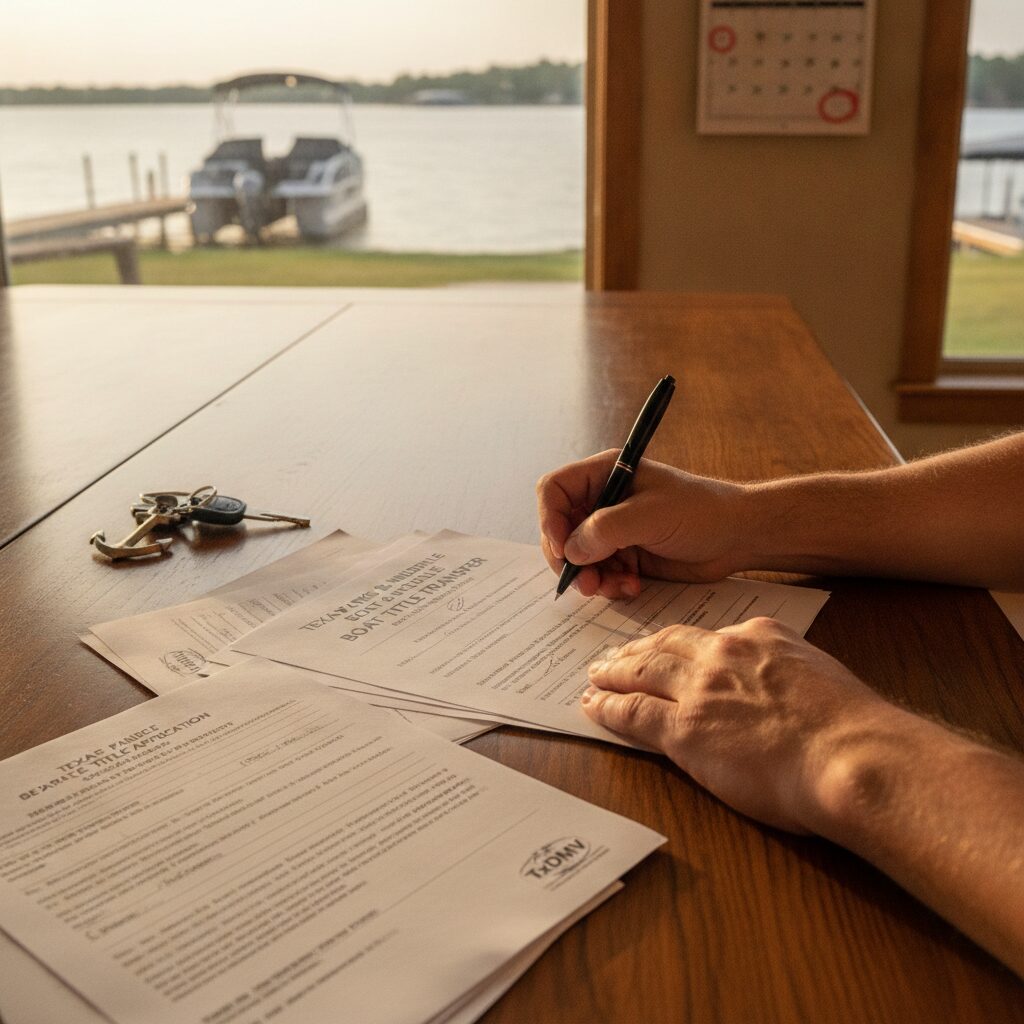
- PWD 143 — Texas Certificate of Title. Sign the back exactly as your name appears on the front. If it’s a joint title with “AND” between names, both signatures are required. “OR” means either one.
- PWD 143M — Application for Title/Registration. The buyer fills most of this out, but you complete the seller section and sign. This is what the buyer submits to TPWD.
- Bill of Sale. Include HIN, trailer VIN, motor serial number, sale price, date, and both parties’ info. TPWD accepts a plain bill of sale, but a notarized one protects you if the buyer later disputes the price to reduce their tax bill.
- Trailer title (Form 130-U context). If the trailer is titled separately with TxDMV — which most boat trailers over 4,000 lbs GVWR are — you sign the back of that title and provide the current registration receipt.
Lost your title? File PWD 314 (Application for Replacement Title) with TPWD. It costs $27 and takes about two to three weeks. Do not try to sell without it — buyers with any experience will walk.
The 6.25% Texas boat sales tax, in plain English
Texas charges a 6.25% sales tax on private boat and motor sales, capped at $18,750 per transaction (that cap kicked in September 2019 and it’s a big deal on larger vessels). The buyer pays this, not the seller, when they file the title transfer. TPWD collects it directly.
Three things trip people up:
- The tax applies to the boat and motor together, using the sale price on the bill of sale. TPWD will accept a reasonable declared price but reserves the right to reassess based on standard valuation guides (think NADA/ABOS) if the number looks fishy. Selling a 2022 Yamaha 242X for $8,000 will get flagged.
- The trailer is taxed separately through TxDMV at the same 6.25% rate, based on the trailer’s portion of the sale. Break out the trailer price on your bill of sale — something like “$32,000 boat and motor, $3,500 trailer” — so the buyer isn’t paying boat tax on the trailer or vice versa.
- Family transfers get a break. Gifts between spouses, parents, children, grandparents, grandchildren, and siblings pay a flat $10 gift tax instead of 6.25%. Form PWD 143 has a gift affidavit section.
The penalty structure matters if you’re helping a buyer who’s dragging their feet. Day 1–45 after sale: no penalty. Day 46–60: 5% of tax due. Day 61+: 10%. On a $40,000 boat, that late penalty jumps from $125 to $250 fast.
Trailer registration is its own animal
Here’s where sellers get sloppy. The boat is TPWD’s jurisdiction. The trailer is TxDMV’s. They’re separate agencies with separate forms and separate fees.
Boat trailers in Texas fall into three buckets:
| Trailer GVWR | Title required? | Registration |
|---|---|---|
| Under 4,000 lbs | Optional | Required, standard plate |
| 4,000 – 7,500 lbs | Yes | Standard trailer plate |
| Over 7,500 lbs | Yes | Standard plus safety inspection |
If the trailer was never titled (common on older aluminum single-axle trailers under 4,000 lbs), the buyer can title it for the first time with a bill of sale, a weight certificate from a certified scale, and Form 130-U at their county tax office. Give them a heads-up so they’re not blindsided by a $30 scale-house detour on the way home.
Check the trailer’s current registration sticker before you list. An expired trailer registration is a $200+ ticket for the buyer the moment they leave your driveway, and buyers will use it to negotiate you down. Renewing costs $45–$65 depending on weight class and takes 10 minutes online at Texas.gov.
Pricing against dealer listings without leaving money on the table
Dealers in Austin, Houston, and DFW mark up used inventory 20–35% over what private sellers get. That’s your opening. But buyers know it too, so simply undercutting the nearest dealer by 10% isn’t a strategy — it’s a floor.
Build your price from three data points:
- NADA Guides low retail. This is roughly what dealers pay at auction. It’s your absolute floor.
- Boat Trader and YachtWorld comps for the same make, model year, and engine hours within 300 miles. Filter for private sellers, not dealers, and look at what’s actually sold — not what’s still sitting at the asking price after 90 days.
- Local dealer retail on comparable inventory. Price 15–20% below that, and you’ll get calls within a week during peak season (March through July on Texas lakes).
Engine hours are the single biggest lever. A 2018 Malibu Wakesetter with 180 hours will outsell the same year with 420 hours by $8,000–$12,000 all day. If yours has low hours, put the number in the headline of your listing. If it has high hours, put a recent service receipt in the listing photos to blunt the objection.
What to include in every listing photo set
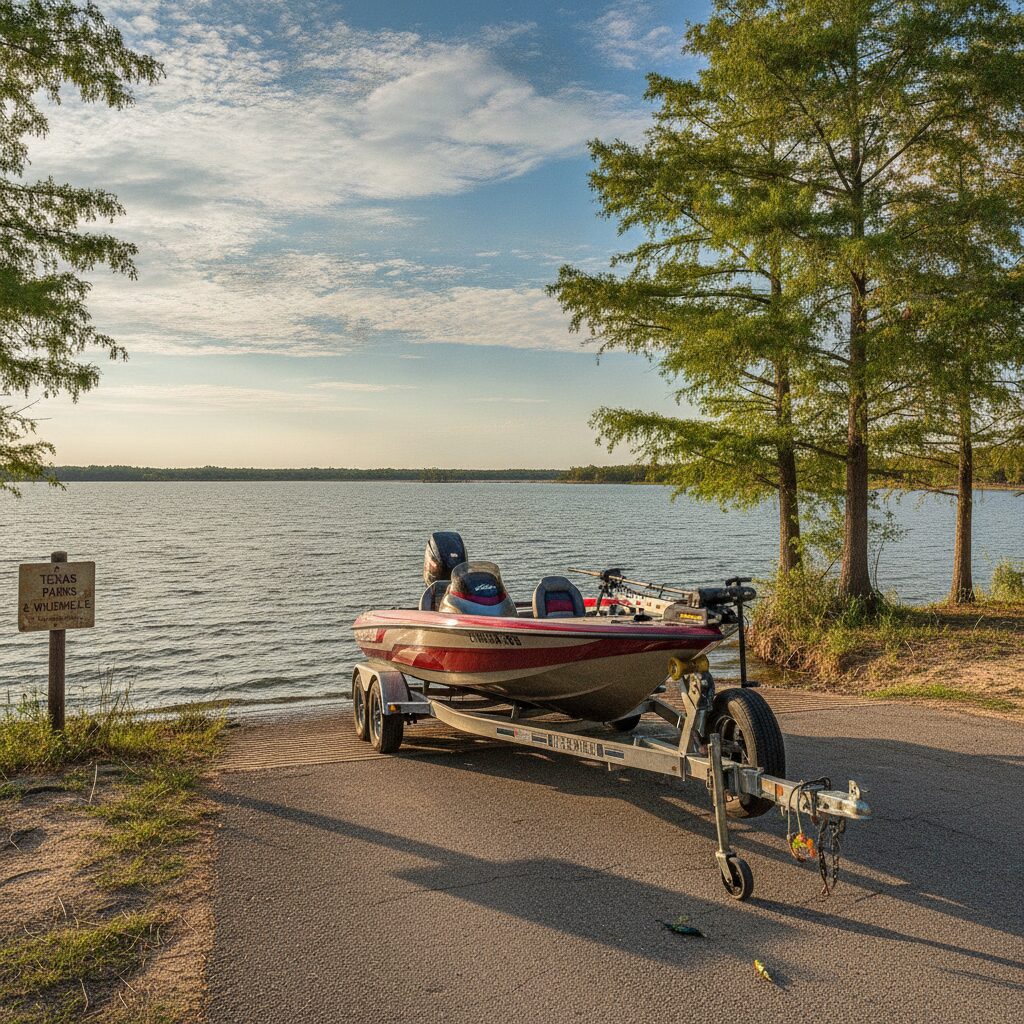
- Bow, stern, and both beam shots on the trailer, taken in daylight against a clean background
- Helm and dash with all gauges lit and engine running
- Upholstery close-ups (buyers assume the worst if you hide the seats)
- Engine compartment with the cowling off
- Hull ID plate — proves you have the boat you claim to have
- Trailer coupler, tires, and lights working
- Any recent service records or receipts, laid flat
Fifteen to twenty photos is the sweet spot. Fewer and buyers assume you’re hiding something. More and they stop scrolling.
The actual sale day checklist
Meet at your bank if the buyer is paying cash or with a cashier’s check — the teller will verify the check on the spot. Never take a personal check, and be careful with Zelle or Venmo above their daily transfer limits (usually $3,500 for new Zelle recipients, which stops most boat sales cold).
At the meeting, in order:
- Buyer inspects the boat and trailer one more time in daylight
- Money changes hands and is verified
- You sign the back of the TPWD title and the trailer title
- Both parties sign the bill of sale — keep a copy, give a copy
- You complete the seller section of PWD 143M
- Buyer takes the hitch and drives away
Then — this is the step private sellers forget — submit a Notice of Transfer to TPWD within 20 days. It’s a free online form at tpwd.texas.gov, and it releases you from liability if the buyer racks up a game warden citation, a fuel dock ding, or worse before they file the transfer.
Common mistakes that kill deals or create liability
- Signing a blank title. Never. Fill in the buyer’s name and the date at the same table where money changes hands.
- Understating the sale price on the bill of sale. Buyers ask for this to save on tax. If TPWD flags it, the buyer gets reassessed and blames you. Not worth the goodwill.
- Forgetting the motor serial number on the bill of sale. If the motor is titled separately from the hull (rare but it happens on older rigs), you’ll create a paperwork nightmare.
- Assuming the trailer transfers with the boat automatically. It doesn’t. Separate title, separate signature, separate tax event.
- Not filing the Notice of Transfer. Free, five minutes, huge liability shield.
When it makes sense to skip private sale entirely
Consignment through a dealer costs 8–12% of the sale price but handles all the paperwork, sea trials, and tire-kickers. If your boat is worth over $60,000 or is a specialty model (offshore center console, wake surf boat, sailboat with rigging complexity), the higher exposure and financing options a dealer provides usually net you more than a private sale — even after the commission. For anything under $30,000 with a straightforward buyer pool, private sale wins on speed and net proceeds almost every time.
Trade-ins are the third option and the worst on price, but they eliminate the sales tax on your next boat purchase up to the trade value. Running the math: if you’re upgrading to a $75,000 boat and trading in one worth $25,000, the trade eliminates $1,562 in sales tax. That’s the real trade-in credit, and it partially offsets the lower price a dealer will offer.
Whichever route you pick, get the paperwork right the first time. A clean title transfer takes 15 minutes. A messy one — missing signatures, wrong HIN, unfiled trailer title — can take six months and a trip to small claims court to unwind.