HVAC Tune-Up Cost in Austin: What’s Actually Included and When to Skip It
The honest HVAC tune-up cost in Austin for 2026 lands between $89 and $249 per system for a standard single-visit inspection. The $89–$129 tier is a basic checklist visit. The $149–$249 tier is a real diagnostic with amp draws, refrigerant pressures, capacitor testing, and a coil rinse. Anything advertised below $69 is a lead-generation call — the technician’s job is to find something to sell you, not to maintain your equipment. Skip the tune-up entirely if your system is under 3 years old, still under manufacturer warranty, and you’ve changed the filter on schedule. Otherwise, spring (March–April) and fall (October) are the right windows, and here’s exactly what you should be paying for.
What Austin HVAC tune-ups actually cost in 2026
Prices have crept up roughly 8–12% over the past two years thanks to R-410A phase-out costs, higher labor rates in the Austin metro, and the refrigerant transition to R-454B on new equipment. Here’s how the current market breaks down across the major service tiers:
| Tier | Price per system | What you get | Time on site |
|---|---|---|---|
| Loss-leader special | $49–$79 | Filter check, visual inspection, sales pitch | 20–35 min |
| Standard tune-up | $89–$129 | 21-point checklist, basic electrical test, condenser rinse | 45–60 min |
| Premium diagnostic | $149–$249 | Full electrical, refrigerant, airflow, and combustion analysis | 75–120 min |
| Annual maintenance plan | $180–$360/year | Two visits (spring + fall), priority scheduling, 10–15% parts discount | Two visits |
Two-system homes in places like Circle C, Steiner Ranch, or newer Leander builds usually get a 10–20% discount on the second unit — expect roughly $75–$100 additional per extra system, not double the single-unit price.
Membership plans deserve a specific note. If a company quotes $19/month, that’s $228/year for two visits. Compare it against paying $129 twice ($258) à la carte. The plan saves ~$30 and gets you priority slots in August, which is worth something the first 100°F week when everyone else waits three days.
What a real HVAC tune-up includes
A legitimate 60–90 minute inspection in Austin should cover a specific set of measurements, not just “eyeballing” components. Ask any company you’re considering to send you their checklist before booking. If they can’t, that’s your answer.
Electrical and safety checks
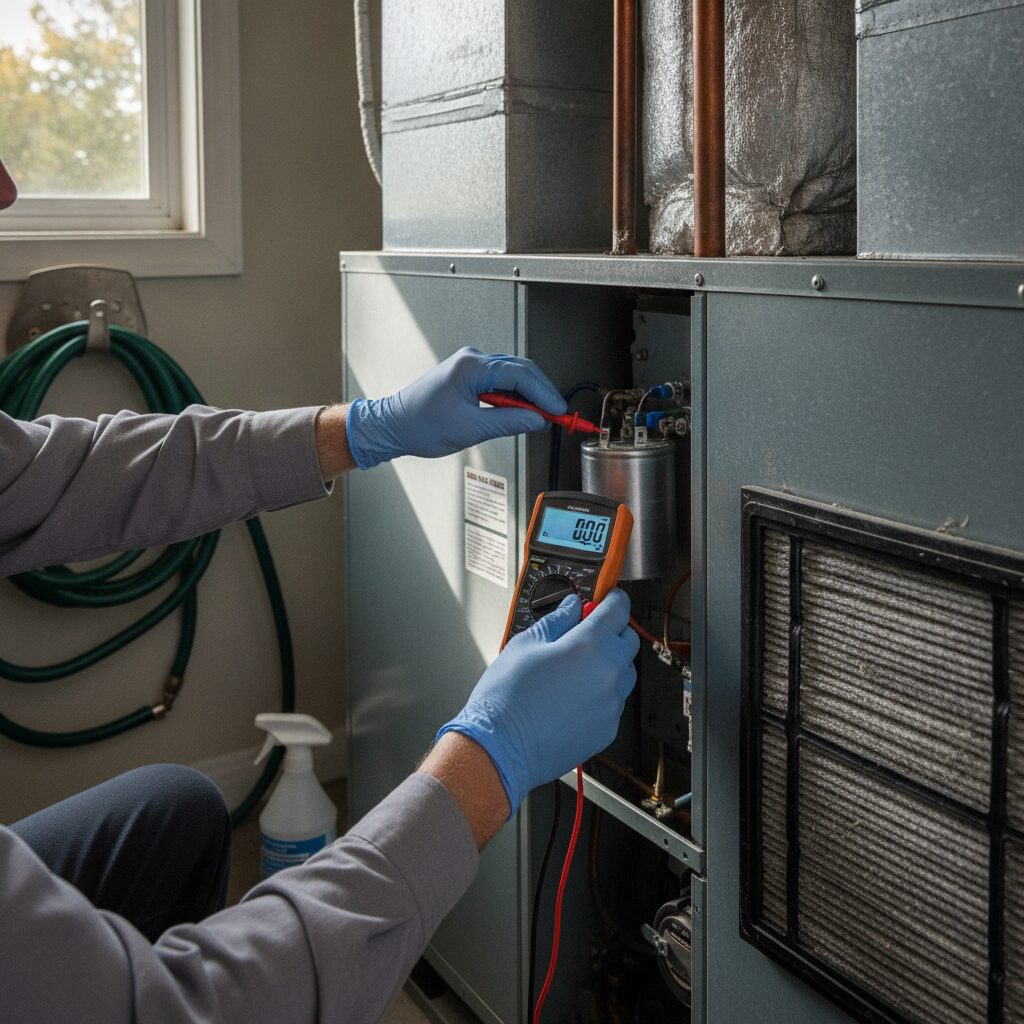
- Capacitor microfarad reading under load, compared against the nameplate rating. A capacitor rated at 45 μF reading 38 μF is failing, even if the unit still runs.
- Contactor inspection for pitting and burn marks. Pitted contactors cause hard starts that eat compressors.
- Amp draw on the compressor, condenser fan, and blower motor, checked against RLA (rated load amps) on the data plate.
- Wire tightness at the disconnect, contactor, and blower — loose connections are the #1 cause of burnt terminals in Austin’s humid summers.
Refrigerant and airflow
- Suction and liquid line pressures, with superheat and subcool calculated. On a 95°F afternoon, an R-410A system should show roughly 118–135 PSI suction and 350–400 PSI liquid, though exact targets depend on the metering device.
- Temperature split across the evaporator coil (return air vs. supply air). 18–22°F is healthy. Under 15°F suggests low charge or a dirty coil.
- Static pressure measurement across the air handler. Anything over 0.8″ WC on a residential system means restricted ductwork or a clogged filter cabinet.
Physical cleaning
- Condenser coil rinse from the inside out with a garden hose (not a pressure washer — that bends fins).
- Condensate drain flush with nitrogen or a wet vac. In Austin’s calcium-heavy water, drain lines clog by late July if not cleared.
- Blower wheel inspection. If it’s caked with dust, you need a pull-and-clean, which is a separate $150–$300 job.
The $89 special: when it’s fine and when it’s bait
A $89 tune-up is not automatically a scam. Established Austin companies genuinely use it as a customer acquisition offer, betting that a certain percentage of homes will need real repairs and become long-term clients. The math works for them at scale.
Here’s how to tell the difference in the first 10 minutes of the visit:
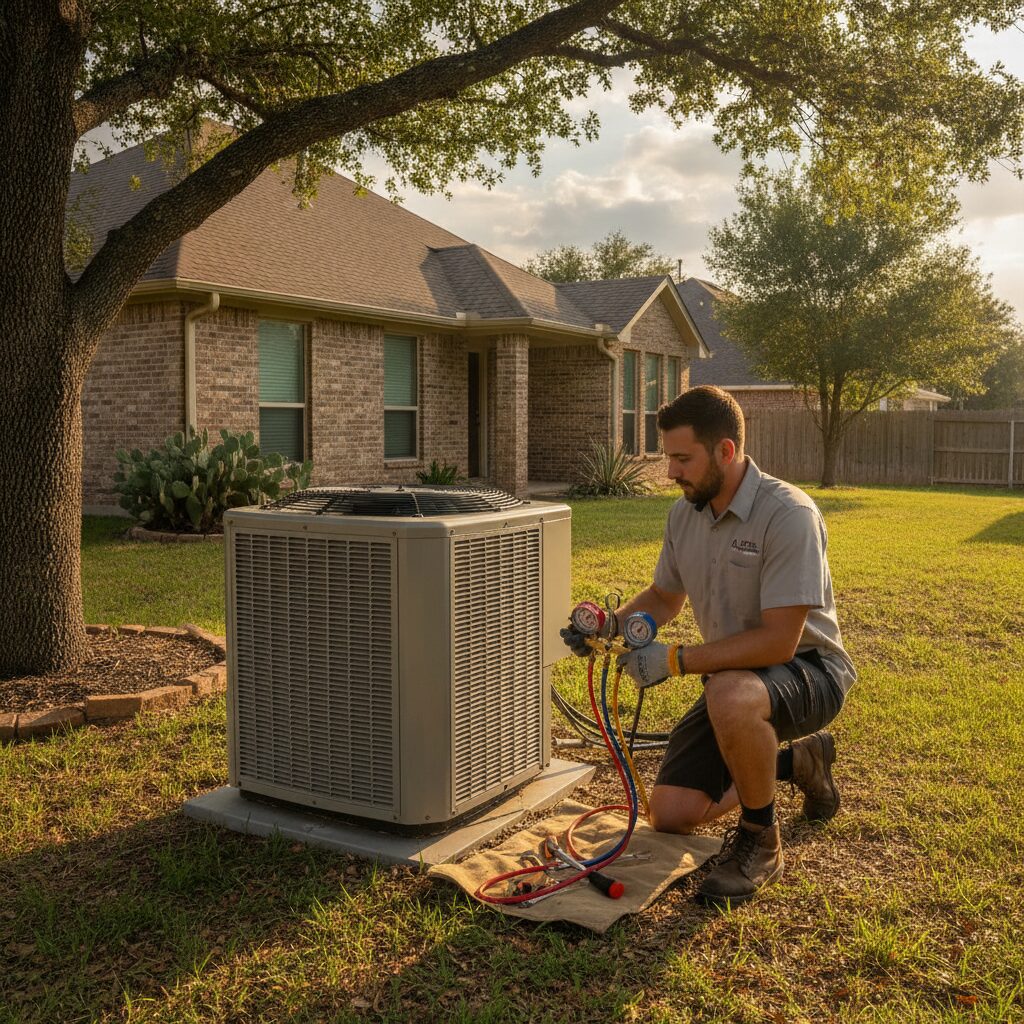
- They bring gauges and a multimeter to the unit. A tech who walks up with only a flashlight and an iPad is there to sell, not to measure.
- They take photos of readings, not just problems. Legitimate techs document capacitor values and pressures. Sales-first techs only photograph rust and dust.
- The written report includes numbers. “Capacitor weak” is a red flag. “Capacitor reading 32 μF against 45 μF rated” is a real diagnosis.
- The upsell threshold is reasonable. If a tune-up visit ends with a $400 quote for surge protectors, hard-start kits, and UV lights on a system that was working fine, you’re being farmed.
The most common bait-and-switch pattern in Austin: tech arrives, spends 15 minutes “inspecting,” then presents a tablet showing a $600–$1,800 list of “recommended” repairs. Capacitors get flagged that are actually within tolerance. Refrigerant gets declared “low” without a leak search. A perfectly serviceable 8-year-old unit gets a full system replacement quote.
Rule of thumb: if the quoted repairs on a tune-up visit exceed $300 and the system was cooling fine when the tech arrived, get a second opinion before authorizing anything.
When to skip the tune-up entirely
Not every system needs annual service. Here’s when writing that check is wasted money:
- System is under 3 years old and under manufacturer warranty. Modern variable-speed equipment self-monitors, and unnecessary tune-ups can actually void some warranties if a non-authorized tech opens sealed components.
- You just had a tune-up 6 months ago and nothing has changed. Twice-yearly service is standard for heat pumps that run year-round, but a gas-furnace-plus-AC combo in Austin often does fine on one spring visit.
- The company charges a diagnostic fee and a tune-up fee on the same visit. Pick one. Paying both is double-dipping.
- Your system is 15+ years old and already needs replacement. A $129 tune-up on a unit with a failing compressor is a $129 delay, not a fix.
Renters in Austin can generally skip it too — HVAC maintenance is the landlord’s responsibility under Texas Property Code §92.052 for habitability, though comfort issues sit in a gray area. If your unit isn’t cooling below 78°F on a 100°F day, that’s a maintenance request, not a tune-up you should pay for out of pocket.
Spring vs. fall: which visit matters more in Central Texas
If you can only pay for one visit per year, make it spring, ideally the first two weeks of April. Here’s why the timing matters specifically in Austin:
Cooling season runs roughly late April through October — six months of hard use with 90+ day counts averaging around 140 per year in the metro. The condenser and compressor take the brunt. Catching a weak capacitor or low charge in April prevents a $400 emergency call in late July when every reputable company is booked three days out and after-hours rates jump to $250+.
Fall visits (mid-October) matter more if you have a gas furnace, since combustion analysis, heat exchanger inspection, and CO testing require the unit to be running. For heat-pump-only homes, which are increasingly common in newer East Austin and Kyle builds, the fall visit is lower stakes because you’ve already stress-tested the compressor all summer.
How to book without getting burned
The Austin HVAC market has roughly 400 licensed contractors plus a long tail of one-truck operations. Quality varies wildly. A few filters that actually work:
- TDLR license verification. Every legitimate HVAC tech in Texas holds a TACLA or TACLB license. Check it at tdlr.texas.gov before the truck arrives, not after.
- NATE certification for the individual tech, not just the company. Company-level branding is easy. Individual NATE certification means the person under your condenser passed a real skills test.
- Flat-rate pricing disclosed before dispatch. “We’ll let you know when we get there” is code for pricing based on how expensive your house looks.
- Reviews mentioning specific technicians by name. Generic 5-star reviews are easy to farm. “Marcus explained the static pressure reading and didn’t push the UV light” is the kind of detail that’s hard to fake.
Booking through a marketplace with vetted local pros — with calendars, upfront pricing, and reviews tied to actual completed jobs — removes most of the guesswork. That’s exactly the model HomeShow.ai uses for local service bookings in the Austin area, so you’re comparing real availability and real prices instead of dialing five companies for quotes.
Red flags during the visit itself
Even after you’ve booked a reputable company, individual technicians vary. Watch for these behaviors:
- Tech refuses to show you the readings on their gauges or meter.
- “Refrigerant is low” without a leak test using electronic detector or bubble solution. Refrigerant doesn’t disappear — if it’s low, there’s a leak somewhere, and topping it off without finding it is throwing money at the ground.
- Aggressive pitch for a full system replacement on a unit under 10 years old with no specific failure identified.
- “Your ductwork is undersized” as an opener on the first visit, before any static pressure or airflow measurements have been taken.
- Hard-close tactics: “This price is only good today,” “If you don’t do this now the compressor will fail this summer.”
Legitimate diagnoses come with numbers, photos, and a written report you can take to another contractor for a second opinion. If any part of that is missing, you’re not getting service — you’re getting a sales presentation you paid for.
The bottom line on Austin HVAC tune-ups
Budget $100–$150 per system per year for real maintenance from a licensed, NATE-certified tech who measures things. Skip the sub-$70 specials unless you already know and trust the company. Book in early April for cooling readiness, and add October if you run gas heat. And when the tablet comes out with a $1,200 list of “recommendations” at the end of a $89 visit, remember that the tune-up wasn’t the product — you were.