How to Sell a Motorcycle Privately in Texas Without Getting Burned
To sell a motorcycle privately in Texas, you need four things in order: a clean signed-off title, a completed Form 130-U for the buyer, a Vehicle Transfer Notification filed within 30 days, and a payment method that can’t be reversed. Texas does not require a bill of sale, but you should write one anyway. Sales tax is the buyer’s problem (6.25% of purchase price or SPV, whichever is higher), except for the odd $90 new-resident case. The biggest risks aren’t paperwork — they’re test-ride crashes on a bike still titled in your name and fake cashier’s checks that clear, then bounce, ten days later.
Here’s the full process, with the Texas-specific quirks that trip up first-time sellers.
Get the Title and Paperwork Right Before You List
The Texas Certificate of Title is the document that actually transfers ownership. If you financed the bike, the title was held by your lender until payoff. Confirm you have the physical title in hand before you list. Lost it? Apply for a certified copy through Form VTR-34 at your county tax office. Cost is $2 in person, $5.45 by mail. Turnaround is typically same-day at the counter and 2–3 weeks by mail.
Check three things on the title itself:
- Owner name matches your ID exactly. If the title says “Robert” and your license says “Bob,” fix it before sale day.
- No active lien recorded. Even a paid-off loan can leave a lien notation. You’ll need a release-of-lien letter from the lender.
- Odometer disclosure section is blank. Federal rules require odometer disclosure on motorcycles less than 20 model years old.
Pull the maintenance records, the original key (and spare, if you have it), and any service receipts from the last two years. Buyers paying cash for a $7,000 sportbike want to see that the valve adjustment was actually done at 16,000 miles.
Pricing the Bike Honestly
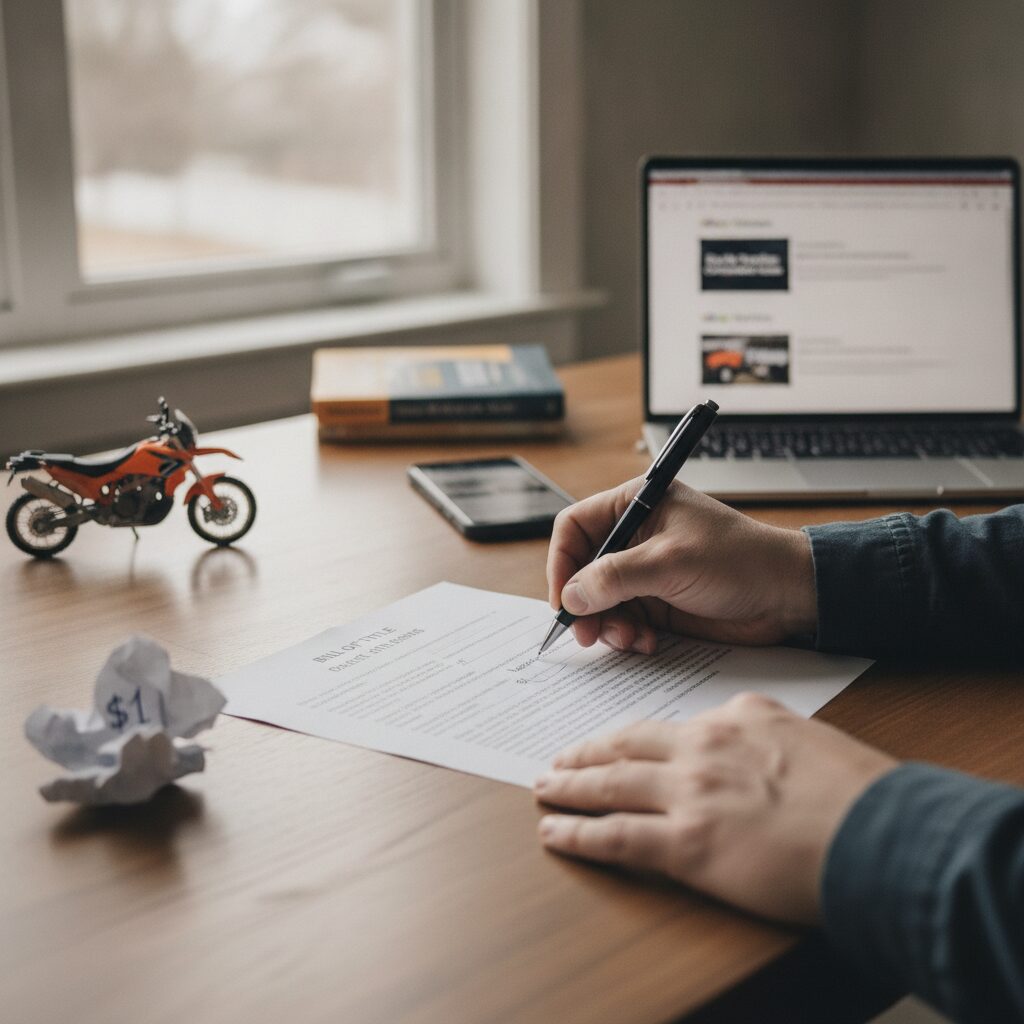
Texas uses the Standard Presumptive Value (SPV) system to calculate sales tax on private vehicle sales, and motorcycles are included. The buyer will pay 6.25% on whichever is higher: the price you both agree to, or 80% of the SPV from the TxDMV database. This matters for you because lowballing the price on the title doesn’t help the buyer — the state will tax them on SPV anyway. Don’t let a buyer talk you into writing “$1” on the title to “save them money.” It doesn’t work, and it makes the transaction look fraudulent.
For pricing comps, check three sources: Cycle Trader listings in Texas (filter to your model and within 250 miles), completed eBay Motors sales, and Kelley Blue Book’s motorcycle tool. Sportbikes and adventure bikes hold value better than cruisers right now. A 2019 KTM 790 Adventure with 12,000 miles is moving in Austin around $7,800–$8,500 as of this writing. A 2015 Harley Street Glide with the same mileage sits closer to $11,000–$13,000 depending on bags and exhaust.
The $90 New Resident Tax Quirk
This one confuses both buyers and sellers. If your buyer recently moved to Texas and is titling a vehicle they already owned out of state, they pay a flat $90 new resident tax instead of 6.25% sales tax. That’s not your bike — that’s a vehicle they brought with them.
The confusion happens when a new Texas resident buys your motorcycle here. In that case, they owe the regular 6.25% (or 80% of SPV), not $90. The $90 rate only applies to vehicles previously registered in their name in another state. If a buyer tries to argue they qualify for the $90 rate on your bike, they’re either misinformed or testing whether you are. Politely correct them and move on.
The exemptions list is short, and most don’t apply to private sales:
- Gift transfers between immediate family — $10 gift tax, requires Form 14-317.
- Inheritance transfers — $10 if titled to the heir.
- Even trades — sales tax on the trade difference only.
Handling Test Rides Without Eating Liability
This is where private motorcycle sales differ sharply from car sales. A buyer crashing your bike on a test ride creates two problems: damage to the motorcycle and potential liability for injuries to the buyer or third parties. Until that title is signed over and the Vehicle Transfer Notification is filed, the bike is legally yours.
Three rules I’d insist on:
- See a valid Class M endorsement. Texas requires a motorcycle endorsement to legally operate a bike on public roads. No M? No ride. This isn’t gatekeeping — it’s your insurance company’s first question if something goes wrong.
- Hold cash or a card imprint equal to the asking price. Not a deposit “to show good faith.” The full price, refundable on return. If they balk, they were never serious buyers.
- Ride a route you choose. Pick a 5–10 mile loop on roads you know. Follow in your car. No highways on the first ride if you can avoid it.
Some sellers refuse test rides entirely and offer only passenger rides or parking-lot starts. That’s defensible on a $25,000 bike. On a $4,000 commuter, you’ll lose buyers. Your call.
Check with your insurance carrier before the listing goes live. Most Texas motorcycle policies cover permissive use, but the coverage limits and deductible apply to your policy, and a claim raises your rates. Progressive, GEICO, and Dairyland all handle this differently.
The Cashier’s Check Scam and How to Beat It
The fake cashier’s check is the single most common scam in private motorcycle sales. Here’s how it works: the buyer hands you what looks like a legitimate cashier’s check from a real bank. You deposit it. Your bank credits the funds in 1–2 business days under Regulation CC. You sign over the title and hand over the bike. Seven to ten days later, the issuing bank reports the check as counterfeit and your bank claws back the deposit. You’re out the bike and the money.
A provisional credit is not a cleared check. The only way to know a cashier’s check is real is to call the issuing bank directly — using the number from the bank’s official website, not the number printed on the check — and have them verify the check number and amount.
Better options for payments over $2,000:
- Meet at the buyer’s bank. They withdraw cash or get a verified cashier’s check made out to you in front of a teller. You verify on the spot.
- Wire transfer, confirmed received. Not “sent” — received. Wires can be reversed within a narrow window if fraud is alleged, but they’re far safer than checks.
- Zelle, with the caveat that limits apply. Most banks cap Zelle at $1,000–$3,500 per day. Useful for deposits, not full payments.
- Cash, counted at a bank. Old-school, but it works. Some Texas credit unions will count and verify cash for you if you’re a member.
Avoid: personal checks of any kind, PayPal Friends & Family for vehicles (against their terms), Venmo for amounts over $5,000, and any buyer who wants to “overpay and have you wire the difference to my shipper.” That last one is always a scam.
Buyer Red Flags Worth Walking Away From
Patterns I’ve seen repeatedly on Texas motorcycle listings:
- “I’m out of state, my shipper will pick it up.” Sometimes legitimate, usually not. Real out-of-state buyers fly in. If they insist on shipping, require payment to clear before pickup and use a real broker like uShip with verified carrier credentials.
- Pressure to close before you’ve met. “I’ll take it sight unseen, just send me your address.” Buyers who haven’t seen the bike don’t send full price upfront. Scammers do.
- Texting from an area code that doesn’t match their story. Not definitive, but combined with other flags it’s a signal.
- Requests for the VIN before any other questions. Title-washing scams start with a clean VIN they can clone onto a stolen bike.
- Refusing to show ID at the sale. If they won’t show a license to sign a title transfer, the transaction can’t happen anyway.
Closing the Sale: The Actual Steps on Sale Day
Once you have a serious buyer with verified funds, the handoff is straightforward:
- Both parties complete Form 130-U. This is the Application for Texas Title. Buyer fills out their portion; you sign as seller.
- Sign the title. Sign exactly as your name appears on the front. Fill in the odometer reading. Fill in the sale price (the real one). Do not date it earlier than the actual sale.
- Write a bill of sale. Two copies, both signed. Include: VIN, year/make/model, odometer, sale price, “sold as-is with no warranty,” both parties’ names, addresses, and driver’s license numbers.
- Remove your plates. Texas plates stay with the seller. The buyer gets temporary tags when they title and register.
- Confirm payment has cleared. Not deposited. Cleared.
- File a Vehicle Transfer Notification (VTR-346) within 30 days. Free, online at TxDMV.gov. This is the single most important step for the seller. Once filed, you’re no longer liable for tickets, tolls, or crashes involving the bike. Skip this and a buyer who never titles the bike can rack up violations under your name for years.
Keep your copy of the signed title (front and back), the bill of sale, the buyer’s ID copy, and the VTR-346 confirmation for at least four years. Texas’s statute of limitations on related civil claims runs that long.
One Last Thing About Cancelling Insurance
Don’t cancel your motorcycle insurance the moment money changes hands. Wait until you’ve filed the VTR-346 and confirmed receipt. If the buyer takes a week to title the bike and crashes on day three, an active insurance policy is your safety net. Most carriers will prorate a refund back to the sale date once you provide proof of transfer.
Done right, a private motorcycle sale in Texas takes about two weeks from listing to closed transaction and nets you 15–25% more than a dealer trade-in. Done wrong, it’s a six-month headache with toll violations and a clawed-back deposit. The paperwork is the easy part. The judgment calls — who to let test ride, which payment method to accept, when to walk away — are what separate a clean sale from an expensive lesson.