Texas Property Tax Protest: How Homeowners Won Reductions in 2025
A successful Texas property tax protest in 2025 came down to three things: filing before the May 15 deadline (or 30 days after your notice, whichever was later), bringing three to five recent comparable sales adjusted for condition, and documenting defects with timestamped photos and repair estimates. Homeowners who did all three averaged 8–14% reductions in market value at the informal stage, according to numbers shared by appraisal district consultants in Travis, Harris, and Bexar counties. Homeowners who showed up with only a complaint walked out with their notice value intact. The difference wasn’t luck. It was a binder — physical or digital — that an appraiser could flip through in under five minutes.
Here’s how the winners built that binder, what evidence moved the needle, and where digital home records like HomeVault changed the math.
The 2025 protest timeline, week by week
Texas appraisal districts mail Notices of Appraised Value starting in early April. In 2025, most districts had notices out between April 1 and April 25. Your deadline to file a protest was May 15 or 30 days after the notice was delivered, whichever came later. Miss it and you lose the year.
The sequence most homeowners followed:
- Early to mid-April: Notice arrives. Pull the appraisal district’s “evidence packet” from their online portal — this shows the comps they used.
- Late April: File the protest online (Form 50-132 or the district’s e-file system). Check both boxes: “value over market” and “unequal appraisal.” You want both arguments open.
- Early to mid-May: Schedule the informal review. About 70% of 2025 protests in major Texas counties resolved here, without an Appraisal Review Board (ARB) hearing.
- Late May through August: ARB hearings for unresolved cases. You get roughly 15 minutes. Bring printed evidence in triplicate.
- After the ARB ruling: Binding arbitration (for homesteads under $5 million) or district court appeal if you still disagree.
One detail people missed: Harris County and Travis County both expanded their iFile/iSettle systems in 2025, letting homeowners submit evidence and accept settlement offers entirely online. In Travis County, the median iSettle reduction was about $22,000 in market value for residential properties that included comp sheets and photos.
What “comparable sales” actually means to an appraiser
The single most effective piece of evidence in 2025 was a clean comp sheet. Not Zillow screenshots. Not a printout of your neighbor’s Redfin estimate. Appraisers want arms-length sales from the prior calendar year, within roughly a half-mile, similar in square footage (±20%), age (±10 years), and condition.
The math they run is simple in concept: take the comp’s sale price, adjust up or down for differences with your house, and see where your property lands. If your house is 2,100 sq ft and the comp is 2,300 sq ft, the appraiser subtracts value for that extra space — typically $60–$120 per square foot depending on the market.
What worked in 2025 hearings:
- Three to five sold comps from January through December 2024, since 2025 values are set as of January 1, 2025.
- Sales pulled from the MLS or the district’s own portal, not estimate sites.
- A side-by-side adjustment grid showing why each comp supports a lower value.
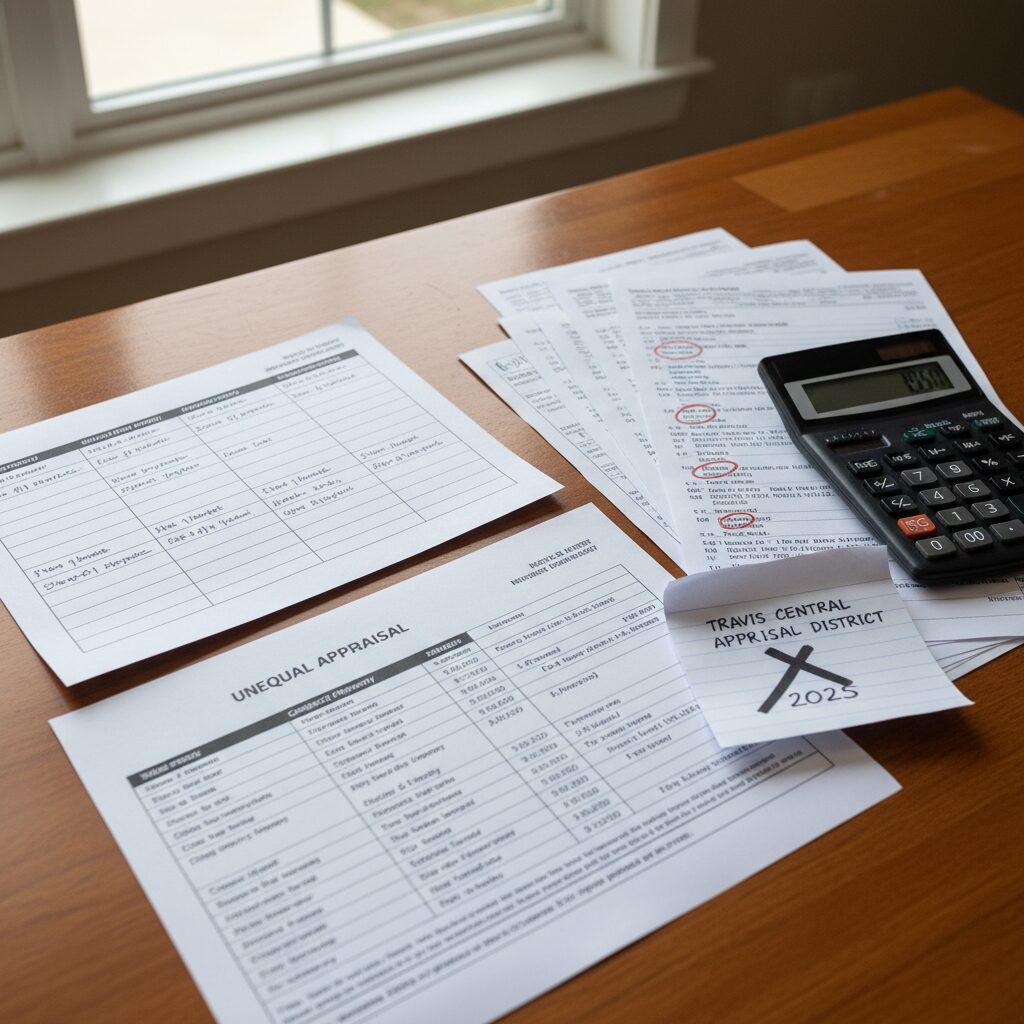
- One or two “unequal appraisal” comps — neighboring homes assessed lower than yours despite being similar. This is a separate, parallel argument under Texas Tax Code §41.43(b)(3).
What didn’t work: pending sales, foreclosures (unless you can show they’re representative), and homes more than a mile away in a different school zone. Travis Central Appraisal District in 2025 explicitly told reviewers to discount comps outside the subject’s neighborhood code.
Condition photos: the evidence appraisers can’t argue with
Appraisers value houses from desks. They use aerial imagery, exterior drive-bys, and the “effective age” assumption that your house is in average condition for its build year. When you show them it isn’t, the number changes.
The photos that moved appraisals in 2025 shared a few traits:
- Timestamped within the last six months. EXIF data matters. A phone photo with date metadata beats a printed snapshot.
- Wide, then close. One photo establishes the room or exterior. The next shows the defect — water staining on a ceiling, cracked slab, failing HVAC, roof granule loss.
- Paired with a repair estimate. A licensed contractor’s written bid is the gold standard. A handwritten quote from a handyman is acceptable. A vague “needs work” note is not.
One Austin homeowner I spoke with reduced her 2025 market value by $41,000 with three pieces of paper: a foundation engineer’s report identifying $18,000 in needed pier work, six photos of interior drywall cracks correlating with the foundation movement, and a 2024 contractor bid for roof replacement she hadn’t yet completed. The informal appraiser accepted all of it in one sitting.
The pattern: defects that affect marketability get weight. Cosmetic issues (dated paint, old carpet) get almost none. Structural, mechanical, and envelope problems — foundation, roof, HVAC, plumbing, electrical — are the ones to document.
How HomeVault records turn memory into evidence
Most protest losses I’ve seen weren’t because the homeowner had a weak case. They were because the homeowner couldn’t prove the case. Receipts disappeared. Repair dates were “sometime in 2023.” Photos sat in a phone camera roll with no organization.
HomeVault, the inventory and warranty tool inside HomeShow.ai, was built for the boring side of homeownership — but it turned out to be useful at the ARB table. A few ways 2025 protesters used it:
- Dated repair logs. When the appraisal district claimed “renovated kitchen,” one Round Rock homeowner pulled her HomeVault entry showing the last cabinet update was 2011 with a $4,200 invoice attached. The “renovated” tag came off her property card.
- Photo timelines. HomeVault stores photos with the original capture date, so a 2023 roof leak photo couldn’t be dismissed as recent staging.
- Warranty and service history. An HVAC system flagged as “new” by the district was, per HomeVault records and the original warranty registration, actually 14 years old. That single correction shifted the depreciation calculation.
- Inventory of known defects. A running list of issues — even small ones — adds up. Five $2,000 problems read differently than one vague complaint.
The Homie™ AI assistant can also draft a basic protest summary from your HomeVault data: square footage discrepancies, age of major systems, documented repairs, and a comp pull from the surrounding ZIP. It’s not a substitute for human judgment at the hearing, but it gets the binder started.
The unequal appraisal argument most homeowners skip
Texas law gives you two independent grounds to protest: market value (your house is worth less than the district says) and unequal appraisal (your house is assessed higher than comparable properties in your neighborhood, regardless of true market value).
The second one is often easier to win and almost always under-used. Pull the appraisal district’s online map. Find 8–10 properties within a quarter-mile that are similar in size, age, and style. Pull their 2025 appraised values from the public record. Calculate the median price per square foot of those properties’ improvements.
If your house is appraised at $185 per square foot and the median of similar neighbors is $162, you have a quantitative case the appraiser can verify in two clicks. In 2025, Harris County ARB panels granted unequal appraisal reductions in roughly 40% of cases where the homeowner brought a clean median calculation.
What the appraisal review board actually wants to hear
If your case escalates to a formal ARB hearing, the format is tight. You’ll face three citizen panelists, an appraisal district representative, and a clock. Fifteen minutes total in most counties.
Structure that worked in 2025:
| Minute | What to cover |
|---|---|
| 0–2 | State your opinion of value and the basis (market, unequal, or both). |
| 2–6 | Walk through 3–5 comparable sales with your adjustment grid. |
| 6–9 | Present condition evidence: photos, repair bids, engineer reports. |
| 9–11 | Present unequal appraisal evidence: neighbor PSF comparison. |
| 11–13 | Respond to the district’s rebuttal. |
| 13–15 | Restate your requested value and close. |
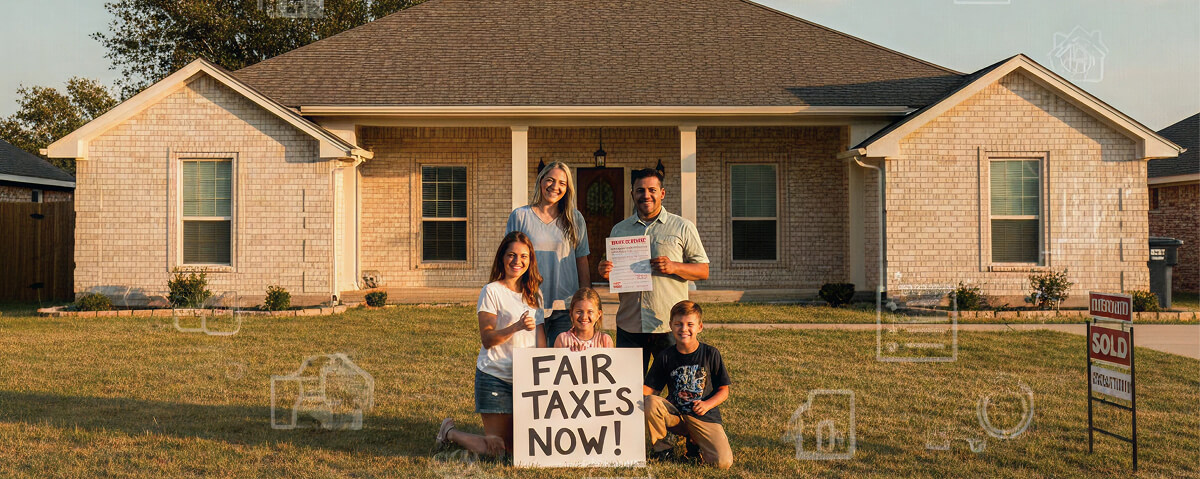
Bring four copies of every document: one for each panelist, one for the district. Panelists are volunteers, often retired. They appreciate clean, labeled tabs. They do not appreciate emotional arguments about taxes being too high — that’s a legislative issue, not an appraisal one.
The numbers from 2025 protests
Some directional data from districts that published 2025 stats or that consultants shared publicly:
- Travis County: About 180,000 residential protests filed. Roughly 62% resulted in some reduction. Median reduction on successful informal protests: 6–9% of market value.
- Harris County: Over 500,000 protests filed across all property types. iSettle acceptance rate hovered near 55% when evidence was submitted.
- Bexar County: ARB hearings averaged 12 minutes. Homeowners with photo evidence won reductions at roughly twice the rate of those without.
- Dallas County: Unequal appraisal arguments succeeded more often than market value arguments for properties under $500,000.
The throughline: showing up prepared was worth thousands. A $30,000 reduction in market value on a homestead in a 2.3% effective tax rate area saves roughly $690 per year — and the reduction often carries forward into the homestead cap calculation for future years.
What to start doing now for 2026
The best protest evidence is collected before you need it. A few habits worth building between now and next April:
- Photograph any defect the day you notice it. Store the photo somewhere with intact metadata.
- Keep contractor bids even for work you don’t do. An unaccepted $12,000 roof bid is still evidence of a $12,000 problem.
- Note the install date and model number of major systems — HVAC, water heater, roof, foundation work. HomeVault has a field for each.
- Check your property card on the appraisal district’s website once a year. Square footage errors, wrong bedroom counts, and incorrect “renovation” flags are common and correctable outside the protest window.
- Save the closing disclosure from any nearby home sale you hear about. Neighbors will sometimes share.
A Texas property tax protest isn’t a courtroom drama. It’s a quiet conversation with a busy person who needs a reason to change a number in a database. Give them three good reasons, on paper, and the number usually changes.