Garage Sale Tips Austin: How to Actually Make Money This Weekend
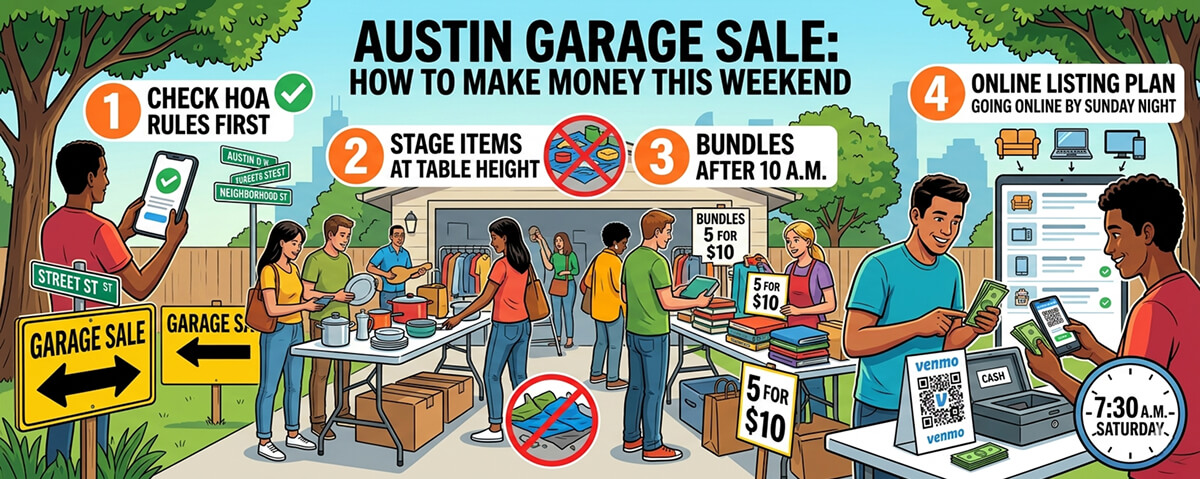
A profitable Austin garage sale follows a tight formula: start at 7:30 a.m. on a Saturday between March and early June or in October, post signs the night before at the three nearest major intersections, price aggressively in round dollars, and have a Venmo QR code taped to the cashbox. Most Austin sellers who break $500 do four things the rest skip-they check their HOA rules before printing flyers, they stage items at table height instead of on tarps, they bundle slow movers after 10 a.m., and they have a pre-built plan to list unsold furniture and electronics online by Sunday night. These garage sale tips for Austin are built around what actually moves in this city, not generic advice copied from a Pinterest board.
Below is the playbook, ordered by the timeline you’ll actually follow: two weeks out, the night before, sale day, and Monday morning cleanup.
Check the Permit and HOA Rules Before You Print a Single Sign
Austin does not require a citywide permit for an occasional residential garage sale, but three things will get you fined or shut down faster than anything else: signs in the public right-of-way, blocking sidewalks, and violating your HOA’s sale-frequency cap.
The City of Austin’s sign code (Chapter 25-10) prohibits garage sale signs on utility poles, traffic signs, and in medians. Code enforcement actively removes them on Mondays, and repeat offenders get citations in the $100–$500 range. Signs are legal on private property with the owner’s permission-your yard, a friend’s yard at the corner, or a willing neighbor’s fence.
HOA rules vary wildly across Austin. A quick scan of common neighborhood covenants:
- Circle C, Avery Ranch, Steiner Ranch: typically limit residents to two sales per year and require signs to come down within 24 hours.
- Mueller: permits the community-wide sale each spring, which is the single best day to sell there-foot traffic does the marketing for you.
- Tarrytown, Hyde Park, Travis Heights: no HOA, but neighborhood Facebook groups will eat you alive if you leave signs up past Sunday.
If you rent, check your lease. Most Austin property management companies require written notice and bar sales in shared-driveway duplexes.
Time the Sale Around Austin Weather, Not Just the Calendar
Saturday is non-negotiable. Sunday traffic in Austin is roughly 40% of Saturday’s, and Friday sales draw mostly resellers looking to flip your stuff at the Saturday markets.
The best months are mid-March through early June and October. July and August will physically hurt you and your customers-anything above 95°F kills walk-up traffic by about half after 10 a.m., and electronics left in the sun warp. December and January work for tools and indoor goods but not clothing or kids’ items.
Check the forecast on Wednesday. If rain is above 40% probability on Saturday morning, move to the following weekend. A wet driveway costs you at least 60% of impulse buyers, and the items you do sell go for less because shoppers don’t want to handle damp goods.
Start at 7:30 a.m. The early-bird resellers will show up at 6:45 no matter what you put on the flyer. Let them. They buy in volume and pay cash. Close at 1 p.m. anything later in an Austin spring is wasted heat and dwindling traffic.
Pricing Psychology That Works on Austin Shoppers
The single biggest mistake first-time sellers make is pricing for what they paid. Nobody cares. Price for what the item is worth to a stranger who has to load it into a Subaru in 90 seconds.
Use these benchmarks as a starting point:
| Item | Original Price | Garage Sale Price |
|---|---|---|
| Adult clothing (good brand) | $40–$80 | $3–$5 |
| Kids’ clothing | $15–$30 | $1–$2 |
| Hardcover books | $25 | $1 |
| Small kitchen appliances | $50–$150 | $8–$20 |
| Solid wood furniture | $300+ | $40–$100 |
| IKEA furniture (assembled) | $150 | $15–$30 |
| Power tools (working) | $100+ | $25–$50 |
| Bikes (adult, working) | $400+ | $60–$120 |
Three rules that consistently increase total revenue:
- Round dollars only. $3, not $2.75. Counting change slows transactions and shoppers read odd prices as “this seller is going to haggle hard.”
- Price everything. An unpriced item is a “no” for half of shoppers-they won’t ask. Use blue painter’s tape and a Sharpie; it peels off clean.
- Drop prices at 10 a.m. and again at noon. Put up a “Everything 50% off after 11” sign. Bundling (“fill a grocery bag for $5”) clears clothes and books faster than any discount.
Take Venmo, Cash App, and Zelle. Tape the QR codes to the front of your cashbox. About a third of Austin shoppers under 40 will not have cash, and you will lose those sales if you say “cash only.”
Signage Rules and the Geometry of Foot Traffic
Your signs do 80% of the marketing work. Online posts on Nextdoor, Craigslist, and neighborhood Facebook groups do the other 20% post Thursday night, not earlier.
Sign rules that actually work in Austin:
- Bright neon poster board, black Sharpie, capital letters. Skip the cute fonts. A driver has about 1.5 seconds to read it.
- Three pieces of info, in this order: the words “GARAGE SALE,” an arrow, and the address. Date and time go on a separate, smaller sign below.
- Place signs at the three nearest signalized intersections pointing toward your house, plus one at every turn between those intersections and your driveway. Six to eight signs is the right number for most neighborhoods.
- Use stakes, not tape. Tape fails in Austin humidity by sunrise. Wooden paint-stir stakes from Home Depot are $0.50 and last all weekend.
- Take every sign down by Sunday morning. This is the single fastest way to stay on good terms with neighbors and code enforcement.
Staging Matters More Than You Think
Items on the ground sell for about half of what the same items sell for on a table. Borrow folding tables. Put clothes on a rolling rack if you can — a $30 rack from Target pays for itself in a single sale.
Group like with like. Kitchen on one table. Tools on another. Kids’ stuff in one zone with toys at a child’s eye level (this is the single best way to get parents to stay longer). Plug in lamps and small electronics so shoppers can see they work-a working item sells for triple what an “as-is” one does.
Keep an extension cord and a fresh pack of AA and 9V batteries within reach. “Does it work?” is the most common question, and “let me show you” is the most profitable answer.
Have a Real Plan for What Doesn’t Sell
Even a great Austin garage sale will leave you with 30–50% of your inventory unsold by 1 p.m. The mistake is hauling it back into the garage and dealing with it “later.” Later never comes, and by Wednesday you’ve lost momentum.
Sort the leftovers into three piles before you even start breaking down tables:
- Donate immediately. Goodwill on South Lamar, Salvation Army on Manor Road, and Austin Pets Alive accept drop-offs Saturday afternoon. Get the receipt for taxes-fair market value on a station wagon full of clothes and household goods is usually $150–$300.
- List online tonight. Furniture, electronics, tools, exercise equipment, and brand-name items in good condition almost always fetch 3–10x the garage sale price online. A dresser you couldn’t move at $40 will sell for $120 on a marketplace listing with decent photos.
- Curb it. Anything you wouldn’t pay $5 for goes to the curb with a “FREE” sign. In most Austin neighborhoods it’s gone by morning.
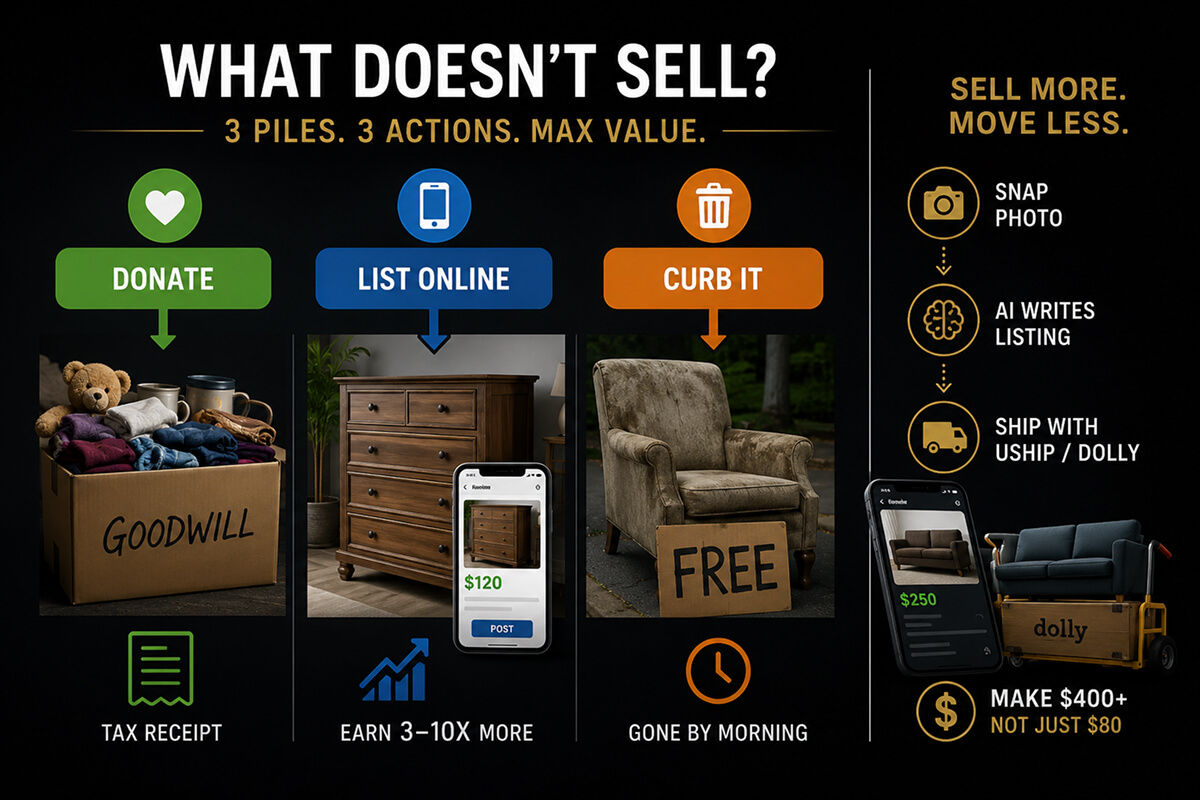
This is where the right tooling pays off. Snapping a single photo of a dresser, couch, or treadmill and having an AI assistant draft the listing-title, description, dimensions, suggested price-turns a 20-minute chore into a 90-second one. Pair that with shipping integrations like uShip or Dolly and you can sell a heavy item to a buyer across town without ever loading it into your own truck. That’s the difference between making $80 at the sale and making $400 across the sale plus the following week.
The Two-Week Timeline
Here’s the schedule that consistently produces a clean, profitable sale:
- Two weeks out: Check HOA rules. Pick a Saturday. Start a sorting pile in the garage.
- One week out: Price everything in stages 30 minutes a night beats one exhausting Friday.
- Thursday night: Post on Nextdoor, Craigslist (still works in Austin), and 2–3 neighborhood Facebook groups. Mention specific high-interest items: “vintage Pyrex, Pelican kayak, electric drill set.”
- Friday evening: Set up tables in the garage. Put signs up after dark (cooler, less code enforcement).
- Saturday 6:45 a.m.: Open the garage door. The resellers are already there.
- Saturday 10 a.m.: Drop prices. Start bundling.
- Saturday 1 p.m.: Stop. Donate, photograph leftovers, take signs down.
- Saturday night: List the high-value leftovers online with shipping options enabled.
What Realistic Numbers Look Like
A typical Austin single-household garage sale with about 200 items grosses $300–$700. A double-household or block sale with 500+ items can clear $1,200–$2,500 if the weather cooperates and signage is done well. Add another $400–$1,500 from online flips over the following 7–10 days for the furniture, electronics, and tools that didn’t move in person.
The sellers who consistently hit the higher end of those ranges aren’t getting lucky. They’re treating the sale like a one-day retail event with a clear marketing plan, a tiered pricing strategy, and a same-day pivot for anything that doesn’t move. Do those three things and a Saturday morning in your driveway will pay better than almost any side hustle you can start in Austin this weekend.