
How to Price a Used Couch for Sale: A Seller’s Guide to Fair Market Value
To price a used couch fairly, start at 20–60% of the original retail price depending on brand tier, subtract for condition flaws, and add or absorb shipping based on how far buyers will travel. An IKEA Kivik that sold for $899 new typically resells for $150–$250 after two years. A West Elm Harmony at $2,400 new holds $700–$1,100. A Restoration Hardware Cloud at $5,500 can still command $2,500–$3,800 in clean condition. Knowing how to price a used couch is mostly about being honest about which curve you’re on, then letting demand pressure do the rest.
Below is the framework I use when helping sellers on HomeShow.ai list large furniture in the Austin metro. It works whether you’re flipping a Craigslist score or unloading a sectional before a move.
Start With the Brand Tier, Not the Original Price
Couches don’t depreciate on a single curve. They depreciate on three, and the brand tier you bought into largely determines which one you’re stuck with.
Budget tier covers IKEA, Wayfair house brands, Walmart, Amazon basics, and most flat-pack sofas under $1,000 new. These pieces lose roughly 70–80% of their value the moment they leave the store. After 12 months, expect to resell at 20–30% of MSRP. After three years, 10–20% if the fabric still looks clean. The reason is simple: buyers can get a brand-new one delivered next week for not much more than your asking price, so your couch competes against Prime shipping.
Mid-tier includes West Elm, Crate & Barrel, Article, Pottery Barn, Room & Board, and Joybird. These hold value better because the lead times on new ones run 8–16 weeks and the build quality is visibly higher. Expect 35–50% of MSRP in year one, 25–40% in year three, and 15–25% by year five. A used Article Sven in tan leather is one of the most liquid items on the secondary market-it usually sells within 72 hours at the right price.
Premium tier means Restoration Hardware, Mitchell Gold + Bob Williams, Lee Industries, Maiden Home, Serena & Lily, and the upper end of CB2. The depreciation curve flattens dramatically here. A clean RH Cloud or Lawson sofa often resells at 50–70% of original for the first five years, especially in slipcovered configurations where buyers can refresh the look with a new cover.
Vintage and designer pieces-Milo Baughman, vintage Knoll, a real Eames sofa compact-operate on their own market entirely. If you suspect you have one, get it appraised before listing.
Grade the Condition Honestly
Buyers of used furniture have been burned. They expect you to oversell. The way to win their trust-and command a higher price-is to grade your couch with the same vocabulary used at consignment shops.
- A / Like New: Less than 12 months old, no visible wear, pet- and smoke-free home, original tags or receipts available. Price at 60–70% of MSRP for premium, 45–55% for mid-tier, 35–45% for budget.
- B / Excellent: Minor wear on high-contact areas (arm tops, cushion seams), no stains, frame solid. Subtract 10–15% from Grade A.
- C / Good: Visible fabric pilling, one small stain or repaired tear, cushions still firm. Subtract 25–35% from Grade A.
- D / Fair: Multiple stains, sagging cushions, pet damage, or smoke exposure. Subtract 50–60% from Grade A. Often best sold to a flipper for $50–$150 regardless of original price.
Two flaws sink prices faster than any other: pet odors and sagging seat cushions. If a buyer sits down and the cushion bottoms out, your Grade B couch just became Grade D in their head. Replace foam inserts before listing if it’s a mid-tier or premium piece-$80–$150 in foam from a local upholstery shop can lift the sale price by $300–$500.
Pull Real Comps Before You Set a Number
Asking prices are fiction. Sold prices are data. Spend 15 minutes pulling at least five comparable sales before you list.
Check Facebook Marketplace (filter to “sold” via the search trick of looking at older listings that have been marked unavailable), Kaiyo, AptDeco, Chairish for mid-to-premium pieces, and the HomeShow.ai marketplace for local Austin comps. For premium brands, eBay’s completed listings filter is still the cleanest sold-price database in existence.
Build a tiny table in your head or on paper:
| Comp | Brand / Model | Age | Condition | Sold Price |
|---|---|---|---|---|
| 1 | West Elm Harmony 92″ | 2 yrs | B | $850 |
| 2 | West Elm Harmony 76″ | 3 yrs | B | $700 |
| 3 | West Elm Andes 86″ | 2 yrs | A | $1,050 |
| 4 | Pottery Barn Sublime | 4 yrs | C | $525 |
| 5 | Article Sven 88″ | 3 yrs | B | $780 |
Now you have a defensible range. List 10–15% above your target sell price to leave negotiating room. Most furniture buyers expect to talk you down at least once.
Let AI Listing Tools Do the Heavy Lifting
Writing a furniture listing from scratch is where most casual sellers lose money. They either underprice because they want it gone, or they overprice and watch the listing rot for three weeks until they panic-discount.
The photo-to-AI listing tool inside HomeShow.ai is built for this exact moment. You upload 4–6 photos of the couch, and Homie™ identifies the likely brand and model, pulls current comp data, suggests a price range, and drafts the listing copy with dimensions, materials, and condition notes. It will also flag things you forgot to photograph-the underside of cushions, the legs, any visible damage-because experienced buyers always ask.
Two practical tips when using AI listing assistance:
- Correct the model identification before you publish. AI is good but not perfect, especially with slipcovered pieces where the silhouette varies by cover. A misidentified West Elm Haven listed as a Harmony will get flagged by knowledgeable buyers and tank your credibility.
- Use the suggested price as a ceiling, not a floor. AI tends to anchor on asking prices from active listings, which skew high. If Homie suggests $950, listing at $899 will typically sell 40% faster.
Factor Shipping Into Your Final Number
This is the step casual sellers almost always skip. A couch isn’t a coffee table. It’s 80–150 pounds of awkward, and how it gets from your living room to the buyer’s heavily influences what they’ll pay.
Three shipping realities to price around:
Local pickup only
You’ll get the lowest sale price but the highest probability of selling within a week. Buyers within a 25-mile radius of Austin will negotiate hard because they’re absorbing the truck rental or Dolly fee themselves. Expect offers 15–20% below asking.
Dolly or TaskRabbit-style local delivery
For metro Austin, Dolly runs $75–$160 for a couch depending on stairs, distance, and time of day. Offering “delivery available for $120 within 20 miles” widens your buyer pool dramatically. Many sellers on HomeShow.ai bundle this into the asking price-listing the couch at $920 with free delivery instead of $800 plus delivery-because buyers respond to the round, all-in number.
uShip for out-of-metro buyers
For premium and vintage pieces, uShip opens up the entire Texas Triangle and beyond. Quotes typically run $1.50–$3.50 per mile for a single couch on a shared route, so Austin to Dallas might be $300–$450, Austin to Houston $250–$400. If your RH sofa is listed at $3,200 and a Dallas buyer is willing to pay $400 in shipping, you’ve just expanded your market by several million people without lifting a finger.
Time the Listing to the Demand Cycle
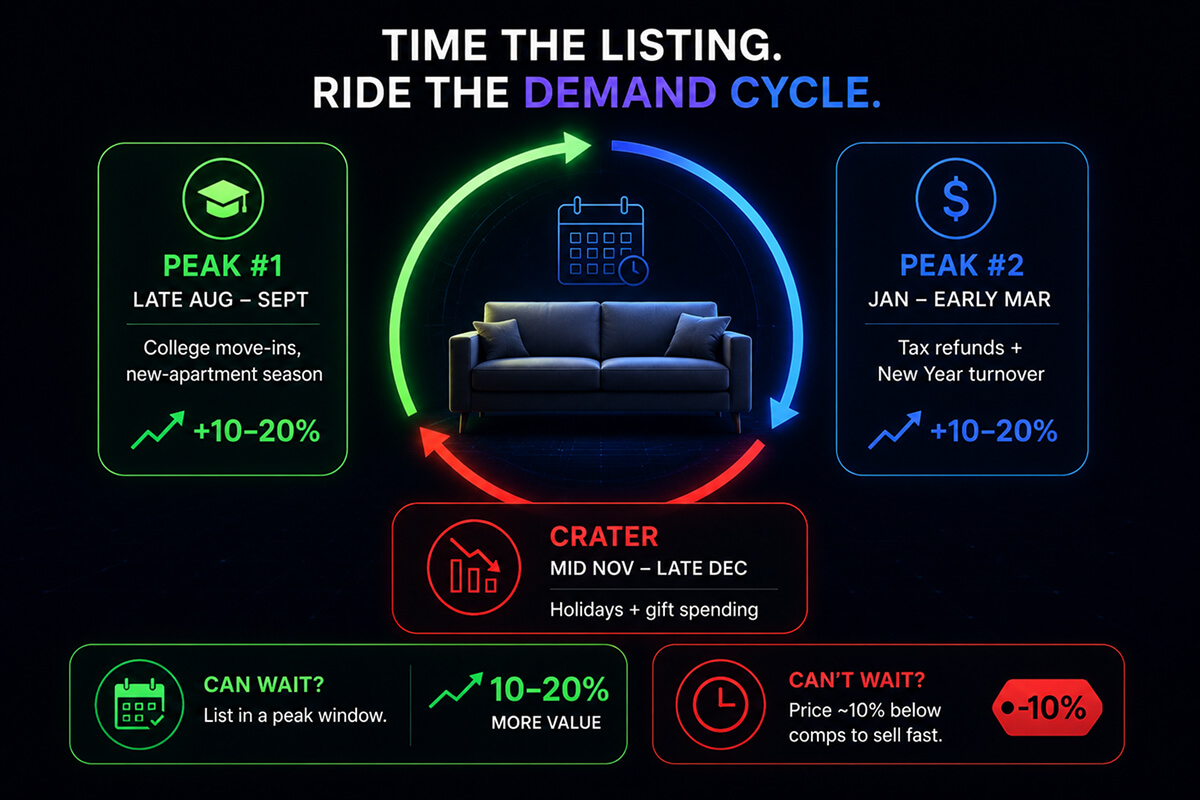
Used couch demand is not constant. It peaks twice a year and craters once.
The two peaks: late August through September (college move-ins, new-apartment season in Austin’s tech corridor) and January through early March (tax refund spending plus New Year apartment turnover). The crater: mid-November through late December, when nobody wants to move furniture during the holidays and everyone’s saving for gifts.
If you can wait three weeks to list during a peak window, you’ll often clear 10–20% more for the same couch. If you’re moving and can’t wait, accept that the calendar is working against you and price 10% below your comps to move it quickly.
A Pricing Walk-Through: Real Numbers
Let’s say you have a three-year-old West Elm Harmony 92″ sofa in performance velvet, originally $2,199, in Grade B condition with no pet exposure and clean cushions.
- Mid-tier depreciation at year three: 25–40% of MSRP = $550–$880.
- Recent sold comps cluster at $700–$850.
- Performance velvet adds a small premium (call it $50) because parents specifically search for it.
- Target sell price: $825.
- List price: $925, with a note that you’ll consider reasonable offers.
- Add: “Local Austin delivery available for $130 via Dolly” or roll it in and list at $1,050 all-in.
That listing, with six clean photos and an AI-drafted description, should generate 5–10 serious inquiries in 72 hours during a normal demand week. If it doesn’t, the price is the problem, not the photos. Drop it by 10%, not 5%-small price cuts get ignored by the algorithm and by buyers who’ve already saved your listing.
When to Just Donate It
Some couches aren’t worth selling. If you bought a $499 fast-furniture sectional three years ago, the realistic sale price is $80–$120, your time investment is 4–6 hours of messages and tire-kickers, and your downside is paying $75 to dump it if nobody bites. Donating to Habitat for Humanity ReStore or Austin’s Treasure City Thrift gets you a tax deduction at fair market value and a free pickup. Run the math honestly-if the spread between sale price and donation deduction is under $150, donate it.
For everything else, the formula holds: brand tier sets the curve, condition sets the multiplier, comps set the range, and shipping decides how wide your buyer pool gets. Price the couch the buyer would actually pay, not the one you wish you could get back.