
Documents to Keep After Selling a House: A Practical Retention Guide
Keep your closing disclosure, final settlement statement (ALTA or HUD-1), deed of sale, Form 1099-S, original purchase records, and every receipt for capital improvements for at least three years after you file the tax return reporting the sale-and ideally seven. Those are the documents to keep after selling a house if the IRS ever asks how you calculated your gain. Toss the routine maintenance receipts, expired warranties, old utility bills, and duplicate listing paperwork. Below is the full list, organized by why each document matters and how long it needs to survive in your filing cabinet (or encrypted cloud folder).
The short version: the IRS can audit a home sale up to three years after filing, six years if you underreported gain by more than 25%, and indefinitely if fraud is alleged. Your records should outlast the longest realistic window.
Why These Records Still Matter After Closing
Selling doesn’t end your paperwork obligations. Three separate parties may come asking for documents months or years later: the IRS (capital gains and 1099-S reconciliation), the buyer (warranty claims, undisclosed defect disputes), and your state revenue department (state-level gain reporting, transfer tax audits).
The single largest tax line tied to a home sale is the capital gains calculation. If you’re single, the first $250,000 of gain on a primary residence is excluded under IRC Section 121; married filing jointly, it’s $500,000. Anything above that is taxable. To prove your gain is below the exclusion-or to compute the taxable portion correctly-you need documentation of your adjusted cost basis. That basis is the original purchase price plus the cost of every qualifying improvement, minus depreciation if any part of the home was rented or used as a home office.
Without receipts, the IRS assumes your basis is what’s on the original closing statement. Every undocumented kitchen remodel becomes phantom gain.
The Documents to Keep After Selling a House
Group these into three folders-physical or digital-labeled Sale, Basis, and Transfer. That structure mirrors how an accountant or attorney will ask for them.
Sale Documents (Keep 7 Years Minimum)
- Closing Disclosure (CD) the five-page form replacing the HUD-1 for most residential sales since 2015. Shows sale price, prorations, payoff amounts, and seller credits.
- ALTA Settlement Statement the itemized version issued at closing. More detailed than the CD on title and escrow fees.
- Form 1099-S issued by the closing agent if your sale exceeded $250,000 (single) or $500,000 (joint), or if you didn’t certify the residence exclusion. The IRS gets a copy; your return must reconcile.
- Signed deed (warranty deed, grant deed, or quitclaim, depending on state) showing transfer to the buyer.
- Mortgage payoff statement from your lender, plus the recorded release or satisfaction of mortgage.
- Final purchase and sale agreement, including all addenda, inspection responses, and the lead-based paint disclosure (federally required for homes built before 1978).
- Seller’s property disclosure statement the one you signed listing known defects. This is your shield against future buyer claims.
- Commission agreement with your listing brokerage and the final commission disbursement.
Basis Documents (Keep as Long as You Owned the Home + 7 Years)
These prove what you paid for the property and what you spent improving it. They reduce your taxable gain dollar for dollar.
- Original purchase closing statement from when you bought the home. Even if that was 22 years ago.
- Original deed showing your acquisition.
- Capital improvement receipts: new roof, HVAC replacement, kitchen remodel, additions, finished basement, deck construction, solar panels, new windows, landscaping that adds value (irrigation, retaining walls, mature tree planting), driveway replacement.
- Contractor contracts and permits for any major work. Permits are often the only contemporaneous proof a project happened in a specific year.
- Assessment notices for special improvements (sewer hookups, sidewalk assessments) that were added to basis.
- Casualty loss documentation insurance claims, repair invoices, and any deductions you took. These adjust basis downward.
- Depreciation schedules if you ever claimed a home office deduction or rented the property. The IRS recaptures depreciation at up to 25% regardless of the Section 121 exclusion.
Transfer and Warranty Documents (Hand Most to the Buyer; Keep Copies 3 Years)
- Manufacturer warranties still in force on the roof, water heater, HVAC, appliances, and windows. Many require the buyer to register the transfer within 30 days.
- Termite bond or pest treatment contracts if transferable.
- Home warranty policy purchased for the buyer at closing.
- Survey, plat map, and any easement agreements recorded against the property.
- HOA documents: bylaws, covenants, current dues statement, and the resale certificate (often called an “estoppel letter”).
- Operating manuals and remote controls for built-in systems gate openers, security panels, irrigation timers, pool equipment.
How Long to Keep Each Category
The IRS statute of limitations is the anchor. Build your retention schedule around it.
| Document type | Minimum retention | Reason |
|---|---|---|
| Closing Disclosure, 1099-S, deed of sale | 7 years after filing | Covers the 6-year substantial understatement window |
| Improvement receipts, original purchase docs | 7 years after sale | Basis support for audit |
| Depreciation records (rental/home office) | 7 years after final disposition | Recapture verification |
| Seller disclosure, inspection reports | State statute of repose (typically 4–10 years) | Defends against latent defect claims |
| Warranty paperwork you kept copies of | 3 years or warranty term | Reference if buyer disputes coverage |
| 1031 exchange documents | Indefinitely | Basis carries forward to the replacement property |
If you did a 1031 like-kind exchange on an investment property, those records never expire in practical terms. Your basis follows you into the next property, and the next, until you sell for cash. I’ve seen exchanges traced across four properties and 18 years.
What You Can Safely Throw Away
Hoarding paper is its own problem. After closing, these can go to the shredder once you’ve confirmed the sale recorded properly (usually 30–60 days post-close):
- Old listing flyers, MLS printouts, and staging consultation notes.
- Showing feedback emails and offer drafts that didn’t get accepted.
- Routine maintenance receipts lawn service, gutter cleaning, furnace tune-ups, carpet shampooing. These are not capital improvements and don’t affect basis.
- Utility bills, unless you used them to prove primary residence for the Section 121 exclusion (in which case keep two years’ worth for the qualifying period).
- Expired homeowner’s insurance declarations from years you no longer need to substantiate.
- Duplicate copies of the same document. Keep one clean original or PDF.
- Old appraisals from refinances unrelated to the sale.
- Pre-approval letters from buyers who didn’t end up purchasing.
The distinction between a repair and an improvement trips up most sellers. Patching a roof is a repair-toss the receipt. Replacing the entire roof is a capital improvement-keep it forever. The IRS test: does the work materially add value, prolong useful life, or adapt the property to a new use? If yes, it’s basis.
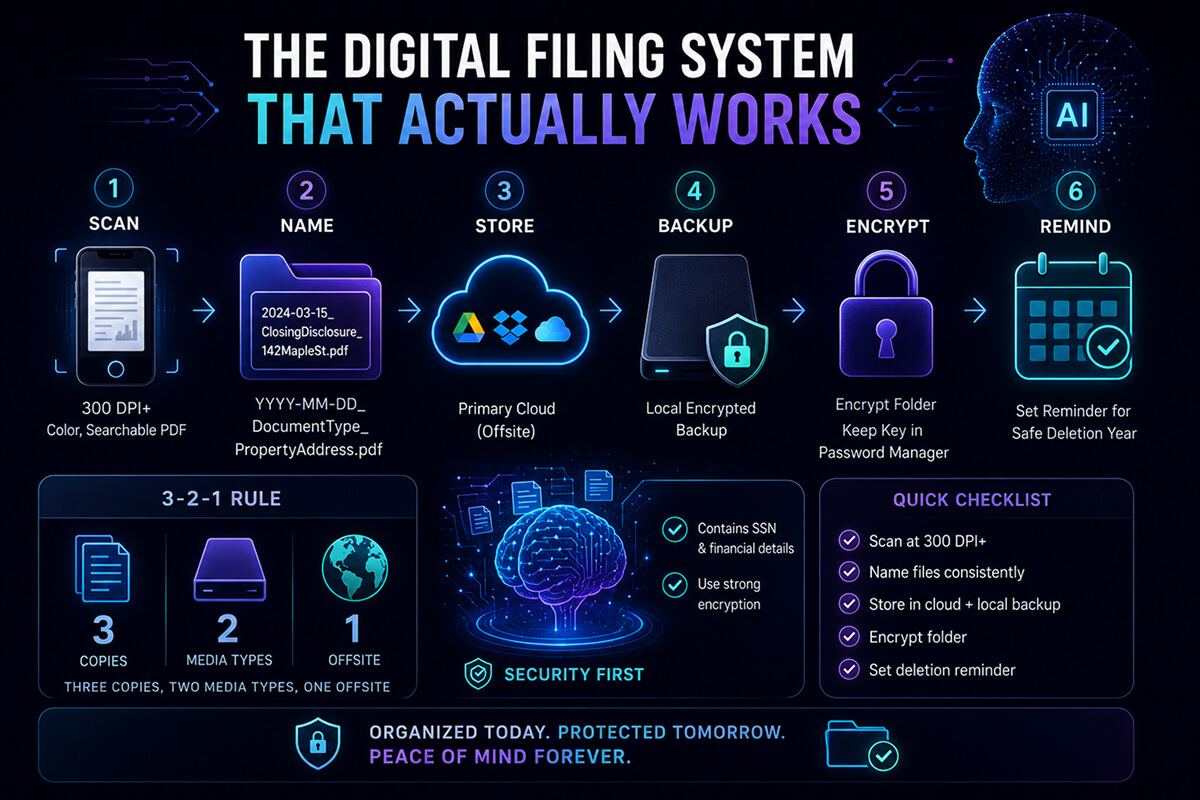
The Digital Filing System That Actually Works
Paper degrades. Boxes get water damage in basements. Move everything to a structured digital archive within 60 days of closing.
- Scan at 300 DPI minimum, color, searchable PDF. A phone scanner app like Adobe Scan or Microsoft Lens handles this for free.
- Name files consistently:
YYYY-MM-DD_DocumentType_PropertyAddress.pdf. So2024-03-15_ClosingDisclosure_142MapleSt.pdfsorts chronologically and searches by address. - Store in two places: a primary cloud service (Google Drive, Dropbox, iCloud) and a local encrypted backup on an external drive. The 3-2-1 rule applies three copies, two media types, one offsite.
- Encrypt the folder. These documents contain your Social Security number on the 1099-S and full purchase details. Use a password manager to store the key.
- Set a calendar reminder for the year you can safely delete. Most cloud services don’t auto-expire files; you’ll need to prune manually.
Keep one physical copy of the recorded deed and final closing disclosure in a fireproof safe or safe deposit box. Recorded documents can be re-pulled from the county recorder, but doing so during a tax audit is a stressful errand.
Special Situations That Change the Rules
Inherited Property
If you sold a home you inherited, your basis is the stepped-up value as of the decedent’s date of death, not what they originally paid. Keep the date-of-death appraisal, the estate’s Form 706 if filed, and any probate court orders confirming the transfer. These supersede the original owner’s basis records, which you can shred.
Divorce-Related Sale
Keep the marital settlement agreement, any quitclaim deed transferring interest between spouses, and the court order if applicable. Under IRC Section 1041, transfers between spouses incident to divorce are nontaxable, but the receiving spouse takes the transferor’s basis-which still has to be documented.
Sold at a Loss
Losses on a personal residence are not deductible. But keep the records anyway-if the IRS questions why you didn’t report gain on a 1099-S, you’ll need to prove the math.
Foreign Sellers
FIRPTA withholding (typically 15% of the sale price) means extra paperwork: Form 8288, Form 8288-A, and any withholding certificate. Keep these indefinitely; refund claims and treaty positions can surface years later.
A Realistic Timeline for the Year After Closing
Here’s how the paperwork actually flows in the 12 months following a sale, based on what tends to arrive when:
- Within 30 days: Recorded deed comes back from the county. Mortgage release records. Final escrow accounting.
- 60–90 days: Any holdback funds released. Final utility reconciliations. HOA refunds.
- January following the sale: Form 1099-S arrives if applicable. Property tax statements showing prorated amounts.
- Tax filing: Schedule D and Form 8949 if reportable gain. Form 4797 if it was a rental.
- Months 6–12: Occasional buyer questions about appliances, contractors, or warranty transfers. Having the folder organized makes these five-minute emails instead of weekend hunts.
One last piece of advice from watching this play out across hundreds of transactions: the people who get burned at audit aren’t the ones who threw away too much. They’re the ones who saved everything in a chaotic pile and couldn’t find the one receipt that mattered. Organization beats hoarding. Build the folder structure now, while the closing is fresh, and your future self or your accountant in 2031-will thank you.